1
How To Determine Which Reader is Right For You
Not all readers are created equal, and for good reason. The application, along with the information demands
of your enterprise data systems, plays the biggest roles in determining the type of reader you need.
Your application may dictate the use of a sophisticated RFID reader capable of controlling peripheral devices based on data read from the
tag, or you may need to attach your RFID reader to a separate local server or a programmable logic controller for local decision making.
The questions below have “either/or” options that can help you determine whether you need a simple reader or a smart reader.
1. Will filtering of redundant tag data need to be performed at the reader level (smart) or by a server or host (simple)?
2. Are Industrial PC’s or PLCs currently used (simple) or will local decision making need to be handled by the reader (smart)?
3. Do you need integration of business processes at the point of activity to minimize RFID integration
without disruption to existing business process and backend systems (smart). Or, are you modifying
your backend system to accommodate new RFID business processes (simple)?
4. Will manipulating the tag data format need to be performed at the reader level (smart) or by a server or host (simple)?
Readers: Simple versus Smart
With a primary function of collecting and passing on tag data,
simple readers rely on a host system “up stream” for decision
making. The host system functions can either be performed
by a tethered handheld or vehicle-mounted computer, or via
a WiFi® or cabled connection to a server or industrial PC. This
is an adequate solution in environments where industrial PCs
are already relied upon to drive application-based decisions.
When the application requires real-time decision making
based on the data collected from the tag, smart readers are the
clear choice. Local intelligence within the smart reader allows
it to not only evaluate the data on the tag, but also respond to
it, such as triggering a red signal light to indicate that manual
intervention is required. Because decisions are made by the reader,
they occur without communications or server-induced delay.
A simple reader, combined with a single antenna, will usually
provide a cost effective solution when 1) there is already a local
controller, 2) tags are consistently oriented the same way and
always located in the same place, and 3) only a few tags travel
through the RF field at a time, relatively slowly. Simple readers
with multiple antennas can alleviate issues with tag orientation,
quantity and speed by increasing the “read field”. Additionally,
simple scanners offer a more economical option for enterprises
that want to leverage their investment in existing handheld
and vehicle-mounted computers to achieve RFID capability.
Smart readers combined with multiple antennas are better
equipped to cope with the unpredictable tag placement,
tag volume and speed, while also providing local filtering.
Smart readers with a single antenna are often mobile
and therefore offer best solution for exception reading
and subsequent tag re-writing because local decision
making can be taken directly to the item to be read.
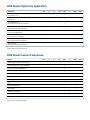
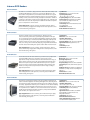
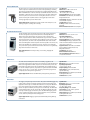
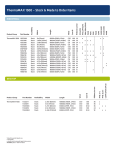
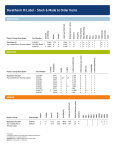
The charts on the following page recommend readers
for specific applications and offer a comparison of
features. Simple readers are identified in gray.