1
2.2. The Scattered Signal as a Function of Time
Besides the position of the meteor trail there are several factors which influence the actual signal as
a function of time:
(1) Where are the geometrical ends of the ionized trail?
(2) What is the speed of the meteor while it is building up the meteor trail?
(3) What is the time-constant of ionization decay?
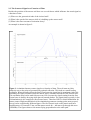
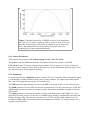
An example is shown in figure 2.
Figure 2. A simulated meteor scatter signal as a function of time. The trail starts at 0.06 s
relatively near to the point of geometrically optimal reflection. This leads to a small leading
oscillation. When the trail reaches the first Fresnel zone the signal has it's maximum. After this
maximum, the signal oscillates while the meteor trail is extended outside the first Fresnel zone.
This oscillation may lead to total fade-out as at 0.22 s because the signal coming from the first
Fresnel zone is already decaying while the trail extends further. The signal phase typically is free
of disturbations in it's central part (first Fresnel zone). Therefore PSK is a useful modulation for
meteor scatter. Slight modifications of the simulation parameters (starting point, meteor speed,
decay) lead to considerably different figures. The first Fresnel zone on the meteor trail has a
length between 2.5 km and 15 km, and the meteor needs 40 ... 400 ms to fly through this zone
(144 MHz). The figure shows a fast meteor flying perpendicular to the radio path.