1
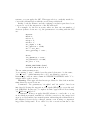
(where x.y.z is the version number) for more info on PWgui, or GUI/README
if you are using CVS sources.
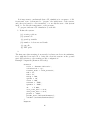
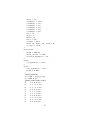
You may take the examples distributed with Quantum ESPRESSO as
templates for writing your own input files: see section 2.3, ”Run examples”.
In the following, whenever we mention ”Example N”, we refer to those. Input
files are those in the results directories, with names ending in .in (they will
appear after you have run the examples).
Note about exchange-correlation: the type of exchange-correlation used
in the calculation is read from PP files. All PP’s must have been generated
using the same exchange-correlation.
4.1
Electronic and ionic structure calculations
Electronic and ionic structure calculations are performed by program pw.x.
Input data The input data is organized as several namelists, followed by
other fields introduced by keywords.
The namelists are
&CONTROL: general variables controlling the run
&SYSTEM: structural information on the system under investigation
&ELECTRONS: electronic variables: self-consistency, smearing
&IONS (optional): ionic variables: relaxation, dynamics
&CELL (optional): variable-cell dynamics
&EE (optional): for density counter charge electrostatic corrections
Optional namelist may be omitted if the calculation to be performed does not
require them. This depends on the value of variable calculation in namelist
&CONTROL. Most variables in namelists have default values. Only the
following variables in &SYSTEM must always be specified:
ibrav (integer): bravais-lattice index
celldm (real, dimension 6): crystallographic constants
nat (integer): number of atoms in the unit cell
ntyp (integer): number of types of atoms in the unit cell
ecutwfc (real): kinetic energy cutoff (Ry) for wavefunctions.
For metallic systems, you have to specify how metallicity is treated by setting variable occupations. If you choose occupations=’smearing’, you have to
specify the smearing width degauss and optionally the smearing type smearing. If you choose occupations=’tetrahedra’, you need to specify a suitable uniform k-point grid (card K POINTS with option automatic). Spinpolarized systems must be treated as metallic system, except the special
39