1
their potential durability. To sabotage the readability of a 1D
symbol, one only has to add another bar to the beginning or
end of the symbol or draw a line through the symbol, parallel
to the stripes.
This throws off the checks and balances, built into the
decoding algorithms of a 1D decoder and makes the symbol
unreadable. By comparison, many degrees of redundancy can
be built into a 2D symbol. While it makes the symbol somewhat
larger, the remaining symbol is remarkably secure.
There are a number of two-dimensional symbologies in
growing use today. The 2D bar code supported by the Card
Software is PDF417.
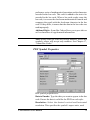
PDF417
PDF417 is a multi-row, two-dimensional, high-capacity, highdensity bar code developed by Symbol Technologies, Inc.
and announced in 1990. It essentially consists of a stacked
set of smaller bar codes. The symbology is capable of
encoding the entire (255 character) ASCII set. PDF stands for
“Portable Data File” because it can encode as many as 2725
data characters in a single bar code comprising 17 modules,
each containing 4 bars and spaces (thus the number “417”).
Each symbol has a start and stop bar group that extends the
height of the symbol.
The complete specification for PDF417 provides many
encoding options including data compression options, error
detection and correction options, and variable size and aspect
ratio symbols. The low level structure of a PDF417 symbol
consists of an array of code words (small bar and space
patterns) that are grouped together and stacked on top of
each other to produce the complete printed symbol. An
186
Card Software User Manual