1
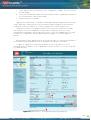
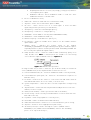
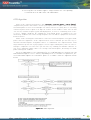
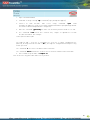
For example, when bad weather has decreased the channel capacity of a link, ACM
maintains high-priority services – such as E1 channels – with full bandwidth capacity while
adapting the bandwidth capacity of low- and mid-priority services such as Internet browsing
(see Figure 4.2).
Figure 4.2.
4.2. ACM bandwidth capacity adaptation
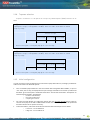
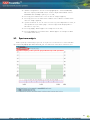
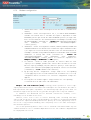
Traffic can be mapped into different priorities, which define the level of service for each
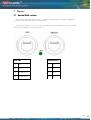
application. Figure 4.3 illustrates how different services – such as rich voice and video – are
mapped into different classes of availability ( CoA) such as 99 .995% or 99 .985%.
(!) Figure 4.3 . represents intermediate modulations. Full range of modulations available is
128QAM, 64QAM , 32APS K, 16APSK, QPS K if ‘128QAM + ACM’ is selected.
The implementation of multiple priorities increases the available capacity up to 10 times
that of standard links. When conditions are clear, the wireless link operates at maximum
capacity and provides all services with the full data rate. When link conditions are poor –
during harsh rain, for example – predefined high-availability services such as voice are not
affected. However, the capacity of low-priority services is adapted dynamically to the changing
link conditions. This is done by provisioning bandwidth according to the link conditions and
traffic priority.
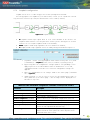
An ACM profile defines the link parameters (modulation) for a given range of the Radial
MSE. The Radial MSE range of each profile defines the threshold for switching from one ACM
profile to another. Each ACM profile has a different spectral efficiency, derived from its
modulation.
The receiver continuously monitors the link condition based on Radial MSE value.
Once the estimators at the receiver side show that the link performance is not suitable for
the current ACM profile, an ACM switching process will be initiated. I n case of degradation in
the link performance, the new ACM profile will include lower modulation, decreasing the link
bitrate. The ACM switching rate is measured in dB/s and is a key feature of ACM systems.
In general, the higher the switching rate, the better the sy stem’s immunity to rapid Radial
MSE changes. When the switching is being executed, the payload rate is being modified to fit
the aggregated data rate to the new available link data rate.
Alternatively, ACM can also be used to increase the link distance, resulting in added link
spectral efficiency. The same concept is implemented as previously, with the margins that
were kept for 99.995-percent bandwidth availability now used to increase the link distance.
Whenever the link conditions are degraded, the sy stem will switch to an ACM profile with
lower spectral efficiency to enable maintaining the link.
28
4Gon www.4Gon.co.uk info@4gon.co.uk Tel: +44 (0)1245 808295 Fax: +44 (0)1245 808299