1
Installation
! Please keep these operating instructions for future
reference. Pass them on to possible new owners of the
appliance.
! Intensive and prolonged use may require additional
ventilation, for example, opening a window or
ventilation more efficient by increasing the suction
power
The appliance has the following technical
specifications:
Category: II 2H3+
Positioning
! Keep packaging material out of the reach of children. It
can become a choking or suffocation hazard (see
Precautions and tips).
! The appliance must be installed by a qualified
professional according to the instructions provided.
Incorrect installation may cause harm to people and
animals or may damage property.
! This unit may be installed and used only in permanently
ventilated rooms in accordance with British Standard
Codes Of Practice: B.S. 6172 / B.S. 5440, Par. 2 and B.S.
6891 Current Editions. The following requirements must be
observed:
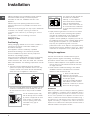
• The room must be equipped with an air extraction
system that expels any combustion fumes. This may
consist of a hood or an electric fan that automatically
starts each time the appliance is switched on.
The system can also provide the
air needed for combustion
indirectly, i.e. from adjacent
rooms fitted with air circulation
tubes as described above.
However, these rooms must not
Enlarging the ventilation slot
be communal rooms, bedrooms
between window and floor.
or rooms that may present a fire
hazard.
• Liquid petroleum gas sinks to the floor as it is heavier
than air. Therefore, rooms containing LPG cylinders
must also be equipped with vents to allow gas to
escape in the event of a leak. As a result LPG
cylinders, whether partially or completely full, must not
be installed or stored in rooms or storage areas that are
below ground level (cellars, etc.). It is advisable to
keep only the cylinder being used in the room,
positioned so that it is not subject to heat produced by
external sources (ovens, fireplaces, stoves, etc. ) which
could raise the temperature of the cylinder above 50°C.
Adjacent
Room
In a chimney stack or branched flue.
(exclusively for cooking appliances)
Fitting the appliance
Gas and mixed hobs are manufactured with type X
degree protection against overheating. The following
precautions must be taken when installing the hob:
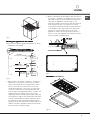
• Kitchen cabinets adjacent to the appliance and taller
than the top of the hob must be at least 50 mm from
the edge of the hob.
• Hoods must be installed according to their relative
installation instruction manuals and at a minimum
distance of 700 mm from the hob.
600mm min.
Directly to
the Outside
• The room must also allow proper air circulation, as air is
needed for combustion to occur normally. The flow of
air must not be less than 2 m3/h per kW of installed
power.
The air circulation system may
take air directly from the outside
by means of a pipe with an inner
cross section of at least 100
A
cm2; the opening must not be
Examples of ventilation holes
vulnerable to any type of
for comburant air.
blockages.
2
Room to be
Vented
540mm min.
! Before operating your new appliance please read this
instruction booklet carefully. It contains important
information for safe use, installation and care of the
appliance.
700mm min.
GB
• Place the wall cabinets
adjacent to the hood at a
minimum height of 540 mm from
the hob (see figure).
If the hob is installed beneath a
wall cabinet, the latter must be
situated at a minimum of 700 mm
above the hob (see figure).
Installation
Make sure you take all the necessary precautions to guarantee
proper installation in compliance with the applicable norms in
force regarding accident-prevention for electrical connection.
For the correct operation of the appliance when built into the
cabinet, it is vital that the minimum distances illustrated in Fig. 1
be respected. The hob features a type Y degree of protection
against overheating in compliance with norms. All surfaces
adjacent to the cabinet and the back panel should be made of
materials resistant to a temperature of 65°C.