1
Also see document about HTB internals - it describes goal above in greater details.
Note: In the literature this is called "borrowing" the excess bandwidth. We use that term below to
conform with the literature. We mention, however, that this seems like a bad term since there is no
obligation to repay the resource that was "borrowed".
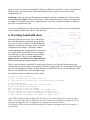
The different kinds of traffic above are represented by classes in HTB. The simplest approach is shown
in the picture at the right.
Let's see what commands to use:
tc qdisc add dev eth0 root handle 1: htb default 12
This command attaches queue discipline HTB to eth0 and gives it the "handle" 1:. This is just a name
or identifier with which to refer to it below. The default 12 means that any traffic that is not otherwise
classified will be assigned to class 1:12.
Note: In general (not just for HTB but for all qdiscs and classes in tc), handles are written x:y where x
is an integer identifying a qdisc and y is an integer identifying a class belonging to that qdisc. The
handle for a qdisc must have zero for its y value and the handle for a class must have a non-zero value
for its y value. The "1:" above is treated as "1:0".
tc
tc
tc
tc
class
class
class
class
add
add
add
add
dev
dev
dev
dev
eth0
eth0
eth0
eth0
parent
parent
parent
parent
1: classid 1:1 htb rate 100kbps ceil 100kbps
1:1 classid 1:10 htb rate 30kbps ceil 100kbps
1:1 classid 1:11 htb rate 10kbps ceil 100kbps
1:1 classid 1:12 htb rate 60kbps ceil 100kbps
The first line creates a "root" class, 1:1 under the qdisc 1:. The definition of a root class is one with the
htb qdisc as its parent. A root class, like other classes under an htb qdisc allows its children to borrow
from each other, but one root class cannot borrow from another. We could have created the other three
classes directly under the htb qdisc, but then the excess bandwidth from one would not be available to
the others. In this case we do want to allow borrowing, so we have to create an extra class to serve as
the root and put the classes that will carry the real data under that. These are defined by the next three
lines. The ceil parameter is described below.
Note: Sometimes people ask me why they have to repeat dev eth0 when they have already used handle
or parent. The reason is that handles are local to an interface, e.g., eth0 and eth1 could each have
classes with handle 1:1.
We also have to describe which packets belong in which class. This is really not related to the HTB
qdisc. See the tc filter documentation for details. The commands will look something like this:
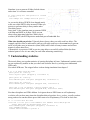
tc filter add dev eth0 protocol ip parent 1:0 prio 1 u32 \
match ip src 1.2.3.4 match ip dport 80 0xffff flowid 1:10
tc filter add dev eth0 protocol ip parent 1:0 prio 1 u32 \
match ip src 1.2.3.4 flowid 1:11
(We identify A by its IP address which we imagine here to be 1.2.3.4.)
Note: The U32 classifier has an undocumented design bug which causes duplicate entries to be listed
by "tc filter show" when you use U32 classifiers with different prio values.