1
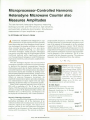
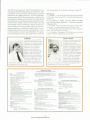
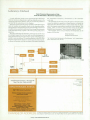
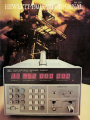
Fig. 1. Model 5342 A Microwave
Frequency Counter measures fre
quencies from 10 Hz to 18 GHz.
With its amplitude measurement
option, it can simultaneously mea
sure and display frequency and
amplitude. Keyboard control and
microprocessor architecture pro
vide ease of operation and data
manipulation features.
where fx = unknown frequency
N = harmonic of frequency synthesizer
fj = programmed frequency of synthe
sizer
fIFl = IF produced by Nf: mixing with fx.
The frequency fa of the programmable synthesizer is
known, since it is known where the indexing of the
Input
IF
Detector
Sampler
Driver
Programmable
Frequency
Synthesizer
synthesizer was stopped. fIFl is known, since it is
counted by the low-frequency counter. Still to be de
termined are N and the sign ( ±) of the IF. This is done
by making one more IF measurement with the syn
thesizer frequency offset from its previous value by
a known amount Af. Thus f2 = fj-Af. This produces
an IF, fIF2, that is counted by the low-frequency
counter. The offset Af is much smaller than the IF, so
if fx is less than Nf1( then fIFl produced by mixing
Nfj with fx will be greater than fIF2. Conversely, if
fx is greater than Nfj then fIF1 will be less than f]F2.
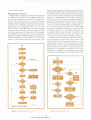
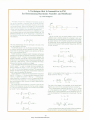
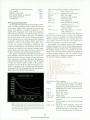
This is shown in Fig. 3. N is then determined as
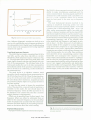
follows:
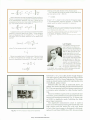
- fx (Nf^fJ
fIF1 =
= Nf2-fx (Nf2>fx)
MF2
N=
Synthesizer
Control
or, if fx is greater than Nf1(
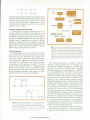
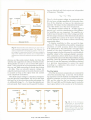
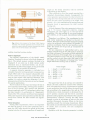
Fig. 2. Simplified block diagram of the harmonic heterodyne
frequency conversion technique used in the 5342 A Counter.
All harmonics of a frequency synthesizer are simultaneously
mixed with the unknown in a sampler. The synthesizer fre
quency is incremented until one of the sampler outputs is in the
range of the low-frequency counter. The system measures this
output, determines which synthesizer harmonic produced it,
and adds the measured value to the known harmonic fre
quency. A microprocessor controls the synthesizer and does
the computations.
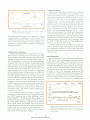
Nf, (Nf,<fx
fIF1
IF2 = fx - Nf2 (Nf2<fx
N=
MFl
The unknown frequency is then computed as
follows:
© Copr. 1949-1998 Hewlett-Packard Co.