1
of dynamic data structures, such as pointers and dynamic arrays; the absence of recursion; and bounded loops. These restrictions may be imposed either through specific language constructs, or programmer annotations on conventional programs.
While specific language constructs, such as those provided in
Real-Time Euclid [1], are useful in as much as they provide
checks for the programs, they come with the usual high costs
associated with a new programming language. Mok and his coworkers [3], Puschner and Koza [2], and Park and Shaw [4],
adopt the latter approach. They all use annotations to existing
programs to fix the bounds on loops. We believe that this approach is more practical, since it involves only minimal additional programming tools.
The timing analysis can be done at either the programming
language level, or the assembly language level. Mok and his
co-workers [3] use the high-level program description to provide functional information about the program through annotations which are then passed on to the assembly language program. We believe that this is the correct approach, the highlevel language program is the right place to provide useful
annotations, since that is what the programmer directly sees.
However, the final analysis must be performed on the assembly
language program so as to capture all the effects of the compiler
optimizations and the micro-architectural implementation.
The functionality of the program determines the actual paths
taken during its execution. Any information regarding this
helps in deciding which program paths are feasible and which
are not. While some of this information can be automatically
inferred from the program, it is widely felt that this is a difficult
task in general. In contrast, it is relatively easier for the programmer to provide such information since he/she is familiar
with what the program is supposed to do 2 . Initial efforts [2, 3]
to include this information were restricted to providing annotations about loop bounds and the maximum execution counts of
a given statement within a given scope. This information, albeit useful, is very limited. It does not capture any information
about the functional interactions between different parts of the
program. Subsequent work by Park and Shaw [4] in this area
attempts to overcome this limitation. They recognize that the
set of statically feasible program paths and other path information can be expressed by regular expressions. The intersection
of these regular expressions represents all the feasible paths,
which can then be examined explicitly to determine the best and
the worst case paths. Although the regular expression is powerful in describing all possible paths, it has several drawbacks.
First, as the authors admit, these are not amenable for specification by programmers. The IDL language interface provided
to the programmer is an exercise in compromise, giving up full
generality for ease of use and analysis. Even so, the complexity
of intersecting regular expressions and the need to examine explicitly a potentially exponential number of paths is still very
prohibitive. In many cases, this results in the use of approximate solutions.
The main contribution of this paper is to provide a method
that does not explicitly enumerate program paths, but rather implicitly considers them in its solution. This is accomplished
2 There is an analog of this in the domain of digital circuits. There, designer
annotations were commonly used to mark paths in the digital circuit that were
never exercised [5]. These paths were then eliminated from consideration in
the timing analysis of the circuit.
by converting the problem of determining the bounds to one
of solving a set of integer linear programming (ILP) problems.
While each ILP problem can in the worst case take exponential time, in practice exponential blowup never occurred in our
experiments. In fact, we observed that in practice, the actual
computation done by the ILP solver is solving a single linear
program. The reasons for this will be briefly examined in Section III, and practical data supporting this will be presented in
Section VI.
III
ILP FORMULATION
A Objective Function
Our objective is to determine the extreme case running times
and not necessarily actually identify the extreme case paths.
This observation led to the following formulation of the problem. For the rest of this section, the focus will be the worst case
timing, the best case can be obtained analogously. Let xi be the
number of times the basic block Bi is executed when the program takes the maximum time to complete. A basic block of
code is a maximal sequence of instructions for which the only
entry point is the first instruction and the only exit point is the
last instruction. Let ci be the running time (or cost) of this basic
block in the worst case. For now let us assume that ci is constant
over all possible times this basic block is executed. This issue
will be examined in more detail in Section IV. Thus, if there
are N basic blocks in the program, the worst case timing for the
program is given by the maximum value of the expression:
N
∑ ci xi
i=1
:
(1)
Clearly, xi ’s cannot be any value. They are constrained by the
program structure and the program functionality, which deals
with what the program is computing and depends on the data
variables. What we need to do is to maximize (1) while taking into account the restrictions imposed by the program structure and functionality. Since (1) is a linear expression, if we can
state these restrictions in the form of linear constraints, it will
enable us to use ILP to determine the maximum value of the
expression. In the following subsections we will demonstrate
how this can be done.
B Program Structural Constraints
The structural constraints are extracted automatically from the
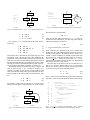
program’s control flow graph (CFG) [6]. This is illustrated in
Fig. 2, which contains an if-then-else statement and its
CFG. In the CFG, we label the edges and the basic blocks by
variables di ’s and xi ’s respectively. These variables represent
the number of times that the control is passing through those
edges and basic blocks when the code is executed. The constraints can be deduced from the CFG as follows: At each node,
the execution count of the basic block is equal to both the sum
of the control flow going into it, and the sum of the control flow
going out from it. Thus, from the graph, we have the following
constraints:
x1
=
d1 = d2 + d3
(2)