1
EPICS Design Process
Design and the Design Process
Dym and Little (2004) define engineering design to be “a thoughtful development of objects that
perform desired functions within given limits.” This “thoughtful development” can be described
as a process. There are many different descriptions of the design process, varying from a few
steps to over a hundred. Although they are different, there is a commonality among them that
conveys a general knowledge of the process associated with design. We have developed the
EPICS Design Process model and will use it in the course to demonstrate and guide you through
the design process.
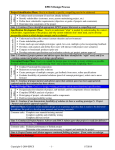
The EPIC Design Process consists of the following phases:
• Problem Identification
• Specification Development
• Conceptual Design
• Detailed Design
• Production
• Service and Maintenance
• (Retirement)
The EPICS Design Process is not intended to be a recipe for design, or simply an exercise that
you need to complete. It is a heuristic (general principle or “rule of thumb”) for design and will
guide your “thoughtful development”, help you to determine the “desired functions within given
limits”. Although the overall goal is to move through the phases, sometimes you gain new
knowledge about the requirements, constraints, context, and/or capabilities of technologies being
used that make it necessary to iterate, or go back to previous phase and complete it again.
Project Identification Phase:
The following are a set of guidelines to help you work through the Project Identification
phase. As you work through this phase, you should touch on each of the major steps listed
below. Some aspects of each step may not be directly applicable to your project, but all
projects will have something related to each of these steps.
The goal of the Project Identification phase is to better understand the need that your project
partner has asked you to help address, and begin to translate the statement of need expressed by
the project partner into tangible and specific requirements that will guide your design. Although
it is tempting to devote very little time and attention to this phase to get to the “real work” of
your project, the success of your project depends on how well you complete this phase. The
knowledge and insight that you learn from this phase should be summarized in the Project
Charter. Both the Project Partner and Team should approve the Project Charter as the guiding
document for the overall project. It is important that the new team members read the Project
Charter to gain an understanding of the motivation. It is also helpful for team members to review
the document throughout the design to prevent scope creep. It is natural for both the customer
and designers to want to add functionality to the design as the progress inspires new ideas.
However, it is important that any changes to the scope be deliberate, and that everyone
understands, and agrees to, the impact of the changes.
The following are a set of tasks to help you begin your project and work through the Project
Identification phase. As you work through this phase, you should touch on each of the major
tasks listed below. For each of the tasks there are guiding questions. Some questions for a
Copyright © 2008 EPICS
-3-
9/14/2008