1
(string or number), a priority, a status, and a
corresponding tuple ID. Each structure has a specific
attribute to depict its affiliation relation: the sub-TCBs
linked list pointer of ECB and the super-Event ID of
TCB. ECBs and TCBs also contain two time
parameters to describe the absolute deadline and the
allowable time-slice. For events, when an event is
defined and activated, the initial value of time-slice,
which is decreasing with the time passing, is equal to
the maximum allowable response time.. These two
parameters are used to evaluate the event priority and
then to determine event scheduling. For threads, the
two parameters are used to avoid the thread deadlock.
TCBs contain two more attributes, i.e. start stack
pointer (SSP) and current stack pointer (CSP), to
indicate a thread’s stack resource space. The stack
space is used to store program counter (PC), status
register(s), general registers and various variables.
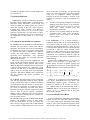
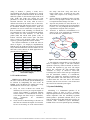
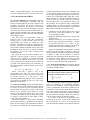
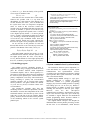
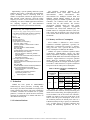
The essential information of ECB and TCB are
shown in Figure 1. To simplify its implementation,
LIMOS stores the ECBs and TCBs in two fixed-size
arrays rather than linked lists since the numbers of realtime tasks (events, threads) in WSN applications are
generally known and limited.
z
z
z
the ‘ready’ state from ‘sleep’ state when its
trigger signal occurs. A thread can also enter
‘ready’ from ‘suspend’ if its waiting resource is
available.
Execute: When an event/thread is being executed.
Due to its non-preemptive feature, an event runs
to completion with no change of its state.
Suspend: Only threads can enter this state. If a
thread which is executing waits for an unavailable
resource, or it was preempted, then the thread is
suspended and ‘suspend’ state is assigned.
Terminate: A thread has self-terminated or is
aborted. If all of its sub-threads are terminated,
the event enters the ‘terminated’ state.
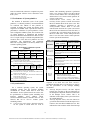
Figure 2. An event and thread state diagram
A state diagram corresponding to event and thread
states is depicted in Figure 2. The state transition
operations exclusively related to threads are traced in
red lines and explained by gray texts. The unique
broken line represents the state transition from
‘terminate’ to ‘sleep’. It should be noted that,
according to the features of the static pre-configuration
and the determinate numbers of events/threads,
LIMOS can combine the predefined ‘terminate’ and
‘sleep’ states into the ‘idle’ state. In this way, an event
or thread enters the ‘idle’ state after it has finished
execution, but the event resource is not released and
the event will be activated by next signal.
Figure 1. Event-control block (left) and Threadcontrol block (Right)
2.3. Event/thread states
LIMOS manages ECBs / TCBs by keeping track of
the states of each event / thread. System scheduling can
be achieved by manipulating the states status. In
LIMOS, events and threads have similar states except
that threads have one more state: ‘suspended’.
z
z
3. System Scheduling
Sleep: An event or thread was created and
initialized, but it is not yet ready and eligible to
execute. Since LIMOS is configured statically
and the numbers of events/threads are fixed, an
event changes state from ‘sleep’ to ‘terminated’,
where
sub-threads
are
reinitialized
correspondingly.
Ready: Events or threads belong to this state are
those that are released and eligible for execution,
but are not executing. An event or thread enters
Scheduling is a fundamental operation of an
operating system. In order to meet a program’s
temporal requirements of a real-time system, it is of the
utmost importance that the scheduling algorithm
should produce a predictable schedule, that is, at all
times it should be known that which task is going to be
executed. With event/thread system architecture,
LIMOS offers a two-level dynamic-priority scheduling
5
Authorized licensed use limited to: SHANGDONG UNIVERSITY. Downloaded on October 27, 2008 at 06:52 from IEEE Xplore. Restrictions apply.