1
evaluation and the last section concludes LIMOS and
gives perspectives.
be associated with one and only one input interrupt
source and n output input sources (0<n≤Max). LIMOS
events run to completion without preemption.
Therefore events are non-preemptive. In terms of the
regularity of occurrences, events are divided into two
classes:
2. System architecture
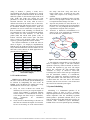
Combining the concepts of event-driven and multithreading systems, LIMOS adopts a component-based
multi-level system architecture: action, thread and
event. In LIMOS, the minimal system unit is termed
action that responds to the basic system operation,
including ‘read’, ‘write’, ‘schedule’, etc. A thread is a
component that consists of a set of actions, which
represents a specific task. An event, which is a supercomponent (container) having a set of components , is
an independent job that consists of a set of tasks
(threads).
z
z
Periodic events: typically suitable for regular data
sampling issued from sensors or for monitoring
actuators, which occur at a fixed rate. Periodic
events have certain execution time and
deterministic response time.
Sporadic events: typically suitable for strict timeconstrained tasks, which occur sporadically.
Sporadic events can be used to deal with the
critical problems.
2.1.4. Architecture. A set of actions construct a
component (thread) and a set of components make up
of a container (event). An event can be viewed as an
automaton. Once being triggered by a signal, the event
is activated and its threads start to be executed. Events
receive/send a signal by calling IN/OUT system
primitives via their related tuple spaces. Providing an
inside view, an event is a set of threads which operate
concurrently and cooperatively. Threads adopt the
same mechanism for inter-thread communication and
synchronization.
Denoting ℜ is a LIMOS instance, ε is an event, τ is
a thread, α is an action and ς is a signal. The ‘ → ’
symbol denotes precedence sequential operation and
‘||’ represents the concurrent or parallel operation. The
LIMOS architecture can be expressed as follows:
2.1. Component-based multi-level structure
2.1.1. Action. Action is the minimal system unit that is
classified into two classes: system action (devicedependent) and function action (device-independent).
To illuminate by serving as an example of WSN, there
are generally four types of actions: ‘read’ operation
(reading data from devices), ‘analyse’ operation
(processing these acquisitions), ‘write’ operation
(transmitting the results) and ‘scheduler’ operation
(thread/event scheduler).
The basic actions have been implemented and
stored into the action library. Threads call an action
directly like calling a library function. Since actions
shield the differences of hardware devices and provide
a uniform calling interface for components, system
designers can thus focus on functions development
with no need of concerning about device-dependent
operations. This feature simplifies the system design
and also improves the system reusability and
compatibility.
ℜ = {ε i : i = 1,2, " , n; ε 1 → ε 2 " → ε n };
ε i = {τ ij : j = 1,2, " mi ; τ i1 τ i 2 " τ im };
{
i
}
(1)
τ ij = α ijk : k = 1,2, " S ij ; α ij1 → α ij 2 " → α ijS .
ij
LIMOS can be configured to run independently in
event driven, multi-thread and event driven with
multithreading (hybrid) modes. Considering two
extreme-case scenarios: if ℜ has only one event, i.e.
n=1, LIMOS works in the multi-threading mode as
SDREAM; while if each event has just one thread, i.e.
∀mi =1, i∈{1,…, j}, LIMOS works in the eventdriven mode as TinyOS.
2.1.2. Thread. Thread represents a task, and interacts
only with the components within the same container
(event). Threads share resources within the containers
and communicate with one another via shared space.
Threads run in concurrence or in parallel to realize a
job (event) by interacting with each other. Hence,
threads are pre-emptive and a thread thus needs a stack
space to store its private “contexts” information.
Sharing resources within the same event reduces the
overheads of thread switching and also decreases the
costs of system resources.
2.1.3. Event. Event represents an independent job that
interacts with peripheral devices or other events.
Events are signal-driven. An event is activated only
after receiving a trigger signal from an ISR (Interrupt
Service Routine). LIMOS defines that each event can
2.2. Event-/thread-control Block
In order to simplify the management and scheduling,
LIMOS allocates two data table structures, named
event control block (ECB) and thread control block
(TCB), to store events and threads respectively. Each
data structure contains at least an identification flag
4
Authorized licensed use limited to: SHANGDONG UNIVERSITY. Downloaded on October 27, 2008 at 06:52 from IEEE Xplore. Restrictions apply.