1
OPERATING & MAINTENANCE INSTRUCTIONAL USER MANUAL
FM STEREO ENCODER SESE-1201(DRAFT
1201(DRAFT Version
Version1.1
ersion1.1)
1.1)
SOME FACTS ABOUT STEREO
Even the best stereo encoder is by itself not enough to guarantee good channel separation at the
receiving side over the whole audio frequency range. Many factors are involved.
(1) THE TRANSMITTER
The first problem usually occurs at the transmitter. Badly designed audio stages of the modulator
will produce low frequency phase shifts, affecting separation. But the main problem is the phase
locked loop section of the transmitter. PLL tries to correct the frequency deviations caused by
the audio effectively canceling modulation. The frequency correcting signal is passed through a
low pass filter (loop filter). This loop filter dampens (smoothes and averages) the correcting
pulses from the PLL circuit before passing the corrected voltage to the frequency control part of
the modulator. The loop filter is usually the cause of the phase shifts due to not being able to
sufficiently dampen and smooth the correcting pulses when the transmitter is fed with low
frequencies. Variable frequency oscillators do not suffer from the problem at all due to no
frequency correcting circuits (PLL). In short, a badly designed transmitter can be hugely
detrimental to the stereo signal created by stereo encoder. Do not jump to the conclusion that
the stereo sound that you are listening to is the stereo encoder only.
(2) THE RECEIVER
Filter Bandwidth and Stereo Decoder of receiver. Even if the transmitter adds no phase shifts to
the multiplex signal transmitted, the receiver (radio) at the listening end can still cause trouble.
The filters in the radio can cause phase shifts to the multiplex if too narrow in bandwidth. Many
cheaper tuners have less filtering (less manufacturing cost) which although not great for
selectivity provides for excellent separation in strong signal environments. The above is only true
if the stereo decoder in the radio or tuner is ok. It is very hard to obtain any modern stereo
decoder chips that give more than 45 dB of separation, some give only 35 dB. So even with
modern day DSP (digital signal processor) stereo encoders that achieve separations of more than
70 dB, you will never hear it because the radio you will be listening to it on may only allow 45 dB
at best. As you see, stereo is not just about a stereo encoder!
Circuit Description
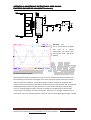
(1) 19kHz Pilot Tone Generator Section
The 19KHz pilot tone comprises a baseband signal, and the L+R and L-R signals consist of DSBSC
(double-sideband-suppressed-carrier) modulation centered at 38 kHz. For a receiver to correctly
demodulate the signal, the transmitted pilot tone and L R signal must synchronize at their
respective zero crossings. In addition, any distortion in the pilot tone produces harmonics that
can interfere with adjacent sections of the signal.
Revised by BG7CR on Nov-1st 2012. Any question please send email to littleshirely@gmail.com
Please visit our website http://www.108MHz.com for more products.