1
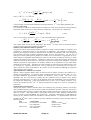
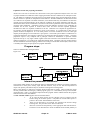
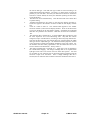
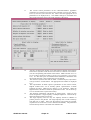
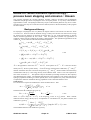
2 I H n4 ∞ 4.10.12 α = 2 π (α ca ) G exp( −ζ )dζ kTe z 02 ∫0 with ζ = (Wn / I n − 1) / kTe and W / I − 1 1 Wn / I n ln(Wn / I n ) + I IP (Wn ) 4.10.13 G = n n − 2 4 Wn / I n + 1 (Wn / I n + 1) IP in the Exchange Classical Impact Parameter ECIP approximation. I is the impact parameter part. ( 3) n 6 2 5 0 b-factors and scaling It is convenient to rewrite the statistical balance equations in terms of the deviations of the populations from those which would occur in thermodynamic equilibrium. The deviation bn is defined by 3/ 2 πa 2 I 4.10.14 N n = N e N + 8 0 H n 2 exp( I n / kTe ) bn kTe Also it is convenient to introduce cn = bn − 1 and scaled temperatures and densities kT 1 kT 1 π πa 03 N e 4.10.15 t e = e 2 , t r = r 2 and ρ e = 2 5 3 α 3 z 07 I H z0 I H z0 with similar forms for the proton temperature and density. In these terms the statistical balance equations become particularly suitable for calculation. Solution of the collisional-radiative equations The general solution of the statistical balance equations to obtain collisional-radiative coefficients and populations is described in detail in the description of ADAS208. The methods of condensation, projection and expansion which give flexibility in the treatment of metastables and in the merging of low resolution and high resolution population models are also described there. For the case of hydrogen in beams entering fusion plasmas, the bundle-n level of resolution is appropriate for all nshells (subject to refinements described below of the key transitions) provided the interest is in beam stopping and integral beam emission. Nonetheless, observations show that principal quantum shell radiative transitions by beam atoms are spectrally resolved into motional Stark multiplets. Using the methods of projection and expansion, the bundle-n solution can be expanded over low n-shell Stark manifolds for a fuller study. ADAS310 has some capability for supporting such studies which it does by accessing an ‘expansion definition file’ and by archiving the ‘condensed-projection matrices’. These aspects have been de-activated for the present version of ADAS310 (although the expansion definition file is still requested). Approximations for collision cross-sections Internal routines calculate default values for electron and ion impact excitation and ionisation in a number of approximations. For electron impact excitation between nearby n-shells ( ∆n ≤ m ~ 2 ), the impact parameter approximation (Burgess and Summers, 1976) is used. The order of the quadrature over the cross-section to produce the rate coefficients may be altered but the highest precision is generally used. For ∆n > m the formulae of Percival and Richard (1970) are available or the simpler Van Regemorter (1962) approximation may be used. For ion impact excitation, crosssections are included for ∆n ≤ m' ~ 2 with the expressions of Lodge et al. (1976) or Vainshtein as alternatives.. Supplementary precision data The general purpose routines described above are satisfactory for generating collision cross-section data at moderate accuracy for the very many n-shell atom population structure. However the precision may be improved for excitation, ionisation and charge transfer involving the ground level and possibly other low n-shells. Such improvement is particularly important for beam stopping coefficients and active or passive Lyman and Balmer line spectroscopy. Systematic improvement is implemented by drawing on the ADAS ion/atom and ion/electron collision database. A supplementation subroutine (SUPPH1 for H0 (HI) ), which is subject to periodic adjustment executes the data acquisition under the following classes class returned data source electron excit. excit. & dexcit. maxwellian. specific ion files (adf04) rate coefficients bundle-n form electron ions. ionis. maxwellian szd files (adf07) rate coefficient ADAS User manual Chap4-10 17 March 2003