1
A.5 Parameters
Some 1D experiments, such as STEAM and ISIS are also written using tr, with
the similar definition that tr is the repetition time per transient.
tr describes the total duration of all events in a pulse sequence, and is never
directly found as an argument to “delay.” Instead, tr is generally used in
precalculations to determine the time required to pad the sum of programmed
events up to the desired repetition time. This padding delay is often found in the
pulse sequence as “predelay.”
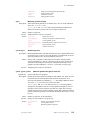
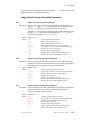
Related:
seqcon
Acquisition loop control (P)
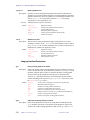
Relaxation delay
trelax
Description: Timing parameter to specify a relaxation delay. A common use for trelax
would be as the inter-image delay in a series of fast images.
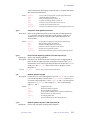
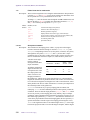
Gradient spoiling time
tspoil
Description: Delay parameter for use in controlling a spoiling gradient. Many imaging
sequences use tspoil to set the additional time that the slice-select gradient
is on, symmetrically bracketing the 180° refocusing pulse, to spoil any
magnetization excited by the 180 itself.
Related:
gcrush
gspoil
tcrush
Crusher gradient level (P)
Spoiler gradient level (P)
Crusher gradient control (P)
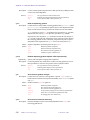
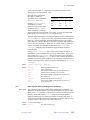
RF Pulse Lengths, Pulse Power Levels, Shaped Pulse Patterns
The predefined rf pulse parameters have been chosen to cover the majority of imaging and
localized spectroscopy applications. In most cases, a trio of related parameters are
available, specifying the pulse length, the associated power level, and an rf waveform shape
if required. An example is the “parameter group” p1, tpwr1, and p1pat. These are, in
fact, three independent parameters, and there is no hard rule that requires them to be
associated. It is convenient to write a pulse sequence so that, for example, the power level
for pulse p1 is tpwr1, and the parameter specifying the shape of p1 is named p1pat.
Standard Varian imaging sequences are written in an attempt to have pulse names follow
the obvious progression of the sequence, and where possible to use names that are
descriptive of their function. For example, an inversion recovery spin-echo sequence would
start with an inversion pulse of length pi (with a power level specified by tpwri and
pattern specified by pipat), followed by the 90° slice selective excitation pulse (p1,
tpwr1, p1pat), and ending with the 180° refocusing pulse (p2, tpwr2, p2pat).
All pulse length parameters are defined in VNMR as type “pulse,” meaning that pulse
durations are entered in µs. The standard limit on maximum pulse length is 8190 µs. Use
the setlimit command to increase the upper limit on length. Remember that pulse
durations are internally converted to seconds for purposes of pulse sequence calculations
(refer to the manuals VNMR Command and Parameter Reference and VNMR User
Programming for more detailed information).
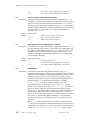
The predefined pulse power parameters have maximum and minimum values derived from
the global configuration parameters parmax and parmin. These limits are specified
during the initial system configuration process (see the command config) and depend on
the system hardware. Power levels are integer values, on a logarithmic dB scale (on VXR
and UNITY generation SISCO systems, a unit change in a power-level parameter
corresponds to a 0.5-dB change in output power). Pulse power levels are controlled by
01-999163-00 A0800
VNMR 6.1C User Guide: Imaging
319