1
Chapter 8. Variable Temperature Operation
be used if the operating temperature does not require the low temperature of liquid
nitrogen. A common alternative is a mixture of dry ice and acetone. Another option is
a fluid such as isopropyl alcohol or ethylene glycol cooled indirectly by a refrigerating
device. Do not use aromatic, ketone, and chlorinated solvents (including acetone) in
the coolant bucket. Such coolant media attack the standard polystyrene bucket.
• The ability of the VT unit to achieve temperature stability is directly affected by the
stability of the room temperature. The VT unit compensates for about 80% of external
changes (leaving 20% uncompensated for). Thus if the temperature of the room
changes by 1°, the sample temperature will change by about 0.2°, which will not be
reflected in a change in the numerically displayed temperature. For best results, the
room temperature should be made as stable as possible. Any cycling of the temperature
due to air conditioning or heating should be accomplished with the shortest possible
cycle time and the minimum possible temperature variation.
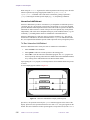
• High-stability and independence from room temperature can be achieved if the VT
controller is equipped with an optional cold junction (CJ) compensator. With the highstability feature, the VT controller is no longer compensated for room temperature
changes, but instead receives its reference from the cold junction devices mounted in
the magnet leg. As the CJ compensator reduces the room temperature influences on the
system, the influences of the VT gas supply become more apparent. For optimum
performance of the CJ compensator, the flow and temperature of the VT gas supply
must be as stable as possible.
• A possible setup to help stabilize the VT gas supply is to run the VT gas through a heatexchanger coil in a water bath at a regulated temperature. For best results, use an ice
bath to cool down the VT gas to between 5°C and 10°C, and keep the flow as stable as
possible for experiments below 40°C. Generally, for best performance of the VT
controller and heater in the probe, the VT gas supply temperature should be a minimum
of 10°C below the set temperature.
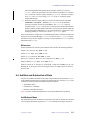
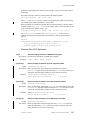
• For exact determination of sample temperature, a temperature calibration curve must
be made for each probe used. All data, such as gas flow, must be noted. Samples of
ethylene glycol are used for high-temperature calibration, and samples of methanol are
used for low-temperature calibration.
a.
After bringing the sample to the desired temperature and allowing sufficient
time for equilibration, obtain a spectrum.
b.
Display two cursors and align them on the two resonances in the spectrum.
c.
If the sample is ethylene glycol, enter tempcal('e'); if the sample is
methanol, enter tempcal('m').
d.
The temperature is calculated and displayed based on the difference
frequency between the cursors.
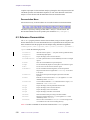
8.5 VT Controller Safety Circuits
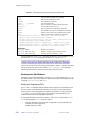
The VT controller includes safety circuits to avoid damage to the heating element and
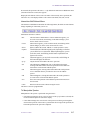
probe. The following error conditions produce an error code in acqstatus[2]:
• Open circuit in the thermocouple circuit.
• Open circuit, short circuit, or over-temperature at safety sensor.
• Short circuit or software/microprocessor failure at the output transistor.
Over-temperature at the safety sensor initially turns off the heater. If this method fails to
correct the condition within 5 seconds, either the gas flow has been interrupted or an output
264
VNMR 6.1C User Guide: Liquids NMR
01-999161-00 A0800