1
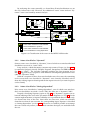
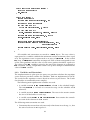
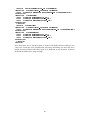
contains the token patterns. In our example, this matrix, which we will call G is
given by
{1, 2} {−1, −4}
0
G=
0
{1, 3, 1} {−1, −3, −1}
In the example the total number of admissible schedules is very large. The
smallest total buffer size that can be obtained is 8. There are 5670 schedules with
this buffer size. One of them is ABCAAABCAAABBCCAAABCBC.
Since, an SDF actor is just a special case of an CSDF actor, it is straightforward
to generate schedules for networks that contains a mix of SDF and CSDF nodes.
Hence, it is only the calculations corresponding to the CSDF case that have been
implemented.
A large problem with the problem of finding minimizing schedules is that it is
NP-complete. Hence, the time required to solve the problem increases very quickly
as the problem size grows and there is no way of knowing how long it will take.
Hence, when solving these problems it is crucial to be able to set a timeout for the
solver.
3.3
Implementation
Finding the repetition vector and the corresponding schedules can be done in many
ways. The problem is a large search problem so one possibility is to write a tailored
depth-first search program with pruning, etc. Another possibility is to use a conventional integer linear programming (ILP) tool such as CPLEX or gtklp or some
mixed integer non-linear programming tool. A third possibility, which is the one
that was chosen here, is to use constraint programming (CP) [10]. The main reason for this is that Krzysztof Kuchinski, the main developer of JaCoP, the CP tool
that we used, is a professor at neighbour department at Lund University, and also
involved in CAL related activities.
3.3.1
JaCoP
JaCoP (Java Constraint Programming) is a constraint solver engine developed for
constrained finite domain variable problems, e.g., integer and boolean problems,
[1]. The scheduling problems above are modeled as a set of constraints over integer variables corresponding to whether a node is executed or not a certain time
step, and to the different buffer sizes. The constraints are given as arithmetic expressions, equalities, inequalities, etc. Depth-first branch-and-bound search techniques are then used together with constraint consistency techniques to find solutions which satisfy given constraints and optimize a given cost function. JaCoP is
written in Java and variables, constraints, and search methods are represented by
Java objects with associated methods.
3.3.2
MiniZinc
An alternative to represent the problem with Java code is to use MiniZinc. MiniZinc is solver-independent constraint modelling language developed within the constraint programming platform project G12 [11]. There are a number of back-ends
that translate a MiniZinc program into the format needed for a particular CP solver,
including JaCoP. For linear problems it is also possible to translate from MiniZinc
to CPLEX. In the JaCoP case, a problem specified in MiniZinc is first converted
to FlatZinc, where, e.g., all loops are unrolled. The abstract syntax tree (AST) for
21