1
Static Direct Limited, 74a The Broadway, Chesham, Buckinghamshire HP5 1EG
Tel: +44 1494 792 177 Fax: +44 1494 794 201 E-mail: staticdirect@btinternet.com
Web: www.staticdirect.com
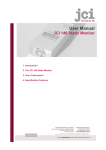
USER MANUAL - JCI 100 STATIC MONITOR
A compact instrument for easy, sensitive and reliable measurement and monitoring of
electrostatic conditions
1. INTRODUCTION
Static electricity causes problems in many areas of industry:
• ignition of flammable gases
• shocks to personnel
• attraction of airborne dust and debris
• cling of thin films and light fabrics
• damage to semiconductor devices
• upset of operation of microelectronic system operation
Static electricity arises when materials in contact are separated and the speed of charge
movement on either surface and away to earth is long compared to the time for the
surfaces to move apart.
Many operations in industry and normal life involve the contact and separation of
materials that are poor or bad conductors of electricity - plastics are notable examples.
Common examples are the occurrence of sparks when combing the hair or taking off an
acrylic jumper, shocks when getting out of a car and shocks after walking across a nylon
carpet and touching earthed conductors. The separation of such surfaces is often
associated with retention of static charge. Voltages of several thousand volts (and up to
20KV) can be generated on our bodies as we go about normal daily activities. When we
touch a metal object and feel a shock or, for example, when we hear a crackle as we take
off an acrylic jumper we create an electrical discharge. This may give us a shock, damage
a microelectronic circuit or couple into the computer and upset computer operation.
Manufacturing operations may involve the handling of thin sheet materials - for instance
in the printing and packaging industries. Static can cause sheets to stick together or be
attracted to nearby surfaces. This attraction is a particular problem with lingerie that may
tend to cling to the body. It will cause attraction of dust and debris from the air - so
packages become 'dirty' when left on the Supermarket shelf. With powders (for instance
in the pharmaceutical industry) material flow may be restricted. In flammable
atmospheres static build up leading to the occurrence of sparks can cause explosions and
fires - with the risk of loss of life and damage to plant and people.
Controlling static: The secret is to prevent any major build-up of static on people, on
industrial plant or on materials. This requires effective linking to 'earth'. With metal plant
and equipment this means good and reliable earth bonding - links you can see and check.
With many materials it is not so easy. Most plastics are bad conductors of electricity - i.e.
charge does not move easily over or through the material. To enable such materials to
dissipate static fairly quickly they need to have additives included in their manufacture or
have surface treatment. Static charge needs to be able to leak away to earth over and
through materials within a fraction of a second.
(Supply of all Static Direct products & services are subject to standard terms & conditions)
Registered Number 4446650
Vat Registration Number 818257612
28/01/2007