1
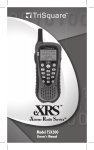
TriSquare TSX300 Features:
• 900-MHz FHSS Frequency-Hopping Spread-Spectrum
technology (less interference and potentially better
propagation than FRS/GMRS)
• 10 billion virtual channels (good privacy; not easily
monitorable)
• License-free, unrestricted personal & business use
• NiMH battery pack - or use (3) AA alkaline cells
• Wireless cloning of contacts & configuration
• NOAA weather receiver (no SAME decoder)
• Hands-free (VOX) w/3 sensitivity levels
• VOX/PTT headset w/boom microphone
• Private "one-to-one" or "one-to-many" voice/text
communications
• Real-time communications (no appreciable vocoder latency)
• Backlit LCD (bitmapped w/up to 7 lines of text & icons)
• Backlit 16-button alphanumeric keypad with 2 Softkeys
• Contact List: 100 names (up to 8 alphanumeric chars)
• SMS-like text messaging (up to 80 chars)
• Page/call alert (ringtone or vibrate)
• Caller ID w/name
• Call waiting w/name
• Non-volatile memory
• 5 ringtones (not assignable)
• Transmitter timeout (0–120 sec)
• Battery meter w/low battery alert
• Dual drop-in desktop trickle charger
• Standard 2.5-mm headset jack
• Keypad lock
• Roger beep
• Keybeep
• Removable swivel belt clip
• One-year manufacturer’s warranty
TriSquare TSX300 Specifications:
• FCC ID: O9GTSX300
• Transmitter: 1-watt ERP; FHSS 906.275–923.750 MHz
• 700 hopping frequencies; 25-kHz spacing, 400-msec/hop
• 10 billion virtual channels (unique frequency-hopping
patterns)
• Transmission protocol: Half-duplex TDMA
• 4.0 kHz FM RF deviation (nominal)
• 3.0 kHz compressed audio bandwidth (nominal)
• Receiver: (nominal specifications)
• Sensitivity (12 dB SINAD): -124 dBm
• Adjacent channel rejection: 50 dB
• Audio output @10% THD: 330 mW
• S/N ratio: 60 dB
• NOAA WX sensitivity (12 dB SINAD): -118 dBm (nominal)
• NOAA WX selectivity (adjacent channel): 60 dBm (nominal)
• Battery types: NiMH 4.8V 750mAH or (3) AA Alkaline cells
• Battery life: NiMH pack: 15 hrs; AA alkaline cells: 45 hrs
(5/5/90 duty cycle)
• Dimensions: 4-3/4 x 2 x 1-1/4 inches HWD (not incl. 1-inch
non-removable antenna)
• Weight: 4 oz. (113grams) without batteries
Figure 2. TriSquare TSX300 features and specifications.
tones or silent (vibrate) alert, hands-free
operation, caller ID with name, call waiting with name, and voice/text privacy.
(See Figure 2 for a complete list of
TSX300 features and specifications.)
The TSX300 comes from the factory
with its default “My Radio” channel set
to 0, but you can assign any channel from
0 to 9999999999 (that’s 10 billion channels). The radio will constantly monitor
that channel, regardless of what “Group
Channel” you happen to be using. Group
Channels, or Contacts, are used for communicating between groups of people and
are not the same as the “My Radio” channel on your or others’ radios, which are
always used for Private Channels. It’s a
little confusing at first, but after reading
the illustrated step-by-step manual and
navigating through the fairly intuitive
menus it becomes clear. To paraphrase an
old advertising slogan, “This is not your
father’s two-way radio.”
TriSquare suggests using your 10digit telephone number as your unique
“My Radio” 10-digit channel code
because it’s unique and easy to remember. But if communications security
(COMSEC) is a concern, such a publicly
22 / POP’COMM / March 2008
available number would be a poor choice.
One hundred Group Channels (i.e.,
Contacts) can be entered and labeled with
up to eight alphanumeric characters, such
as George, Basecamp, Warehouse,
Security, and A-Team.
Theory Of Operation
The TriSquare TSX300 is a hybrid
digital/analog two-way radio designed to
make the best and most economical use
of both technologies. Its proprietary
eXRS FHSS scheme uses 700 frequencies spaced 25 kHz apart between
906.275 and 923.750 MHz. Heavy concentrations of cordless telephone traffic
around the top and bottom of the licensefree 902–928 MHz ISM band led
TriSquare engineers to avoid interference
on those frequencies, as well as with the
most commonly used portions of the 33cm amateur radio band, which is allocated on a shared/secondary basis (many of
TriSquare’s engineers are hams).
Depending on which 10-digit channel
code is chosen, an embedded pseudorandom number generator algorithm selects
a different set of 50 frequencies to hop
and cycle through every 20 seconds. Each
400-millisecond hop frame contains both
voice and data.
Since each radio “knows” (based on the
channel selection) what the hopping frequencies are as well as their order, the
receiving radio(s) need only know when
to start hopping to remain synchronized.
The receiver starts hopping when the preamble signal is received, and stops hopping 20 seconds after no signal is received.
The transmitter’s microphone audio is digitized, modified by a DSP algorithm to
extract only the most useful information,
summed with a digital timing and position
signal, and time-compressed to allow
proper hop framing and provisioning of
the control data (caller ID, private call,
etc.) within each frame. The receiver’s
DSP extracts the modified audio, performs
digital noise reduction, and expands it
back to the original voice signal timing
(slightly delayed after processing).
This scheme is less DSP-intensive
than full-fledged vocoders, such as
VSELP (Vector Sum Excited Linear
Predictive) used by Motorola’s DTR
series of two-way 902–928 MHz FHSS
radios (see “The Motorola DTR410
Scan Our Web Site