1
clips, a dual desktop drop-in charging bay
with AC adapter, and one illustrated
user’s manual.
After installing the two 4.8V,
750mAH NiMH battery packs and dropping the radios into the dual desktop trickle charger for the night, I noted it had
built-in protection against overcharging
and short-circuiting batteries. The charger takes about 12 hours to fully replenish
battery packs that are fully discharged.
The next morning (about 11 hours later)
the radio’s LCD battery gauge indicated
they were fully charged.
A nice feature is the option to use three
standard AA alkaline cells instead of the
included NiMH pack, so in an emergency
you’re never at the mercy of the slow
trickle charger. Additional NiMH battery
packs are sold separately, in case you
want to keep a spare set charging and
ready for action at all times. The plastic
battery cover fit loosely, but TriSquare
informed me this was an early production
problem that has since been fixed. Rated
NiMH battery life is 15 hours based on a
5/5/90 duty cycle (5% transmit, 5%
receive, 90% standby), while standard
AA alkaline cells should provide about
45 hours of 5/5/90 use. My test results
were consistent with those ratings.
Physical Features And
User Interface
Figure 1. A page from the TriSquare user manual depicting some of the TSX300’s many
features and controls.
are practically immune to channel overcrowding and interference.
TriSquare trademarked the names
“eXtreme Radio Service” and “eXRS”
for its new technology and made plans to
overtake the stagnating FRS/GMRS radio
market in just two to three years with a
line of portable FHSS transceivers—
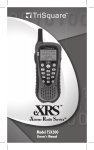
starting with its flagship TSX300 (Photo
A) and its entry-level TSX100 (which has
a very limited feature set but is about onethird the price). TriSquare also laid plans
to establish eXRS as a de facto standard
for licensing to other companies.
These are ambitious goals, but
TriSquare is gambling that its patentwww.popular-communications.com
pending eXRS technology—and the many
new features it makes possible—will be a
big hit with a general public accustomed
to cell phone features and ergonomics, and
who desire a private two-way radio solution with similar features.
Complete Package
Pop’Comm asked TriSquare to send
me an early production TSX300-2VP
“Value Pack” for review (see Photos B
and C), which is a retail peg-display package containing two TSX300 radio transceivers, two PTT/VOX headsets, two
NiMH battery packs, two swivel belt
The TSX300’s appearance and user
interface blurs the distinctions between
two-way radios and cell phone handsets
(see Figure 1). It not only looks a lot like
some cell phones, it also shares many of
their features. The housing is rugged
ABS/PC plastic and slightly larger than a
second-generation non-flip PCS/cellular
handset. Its sides curve slightly inward
and are ribbed to fit comfortably in your
hand, so you can operate the full keypad
one-handed with your thumb.
For day/night readability the 16-button
keypad has silver-painted translucent silicone keys, which are laser-etched with
numerals and all letters of the alphabet. An
Up/Down button and two Left/Right
“Softkeys” allow selection of dynamically displayed functions and menu
options—similar to how many cell phone
menus work. Above the keypad is the large
backlit bitmapped LCD that displays up to
seven lines of text and icons, depending on
the screen and function being viewed.
Other TSX300 cell phone-like features include SMS-like text messaging
with message-waiting indicator, ringMarch 2008 / POP’COMM / 21