1
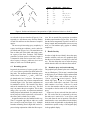
<S>
<NP lex="I"/>
<VP>
<V lex="saw"/>
<NP>
<NP>
<Det lex="the"/>
<Adj lex="old"/>
<N lex="man"/>
</NP>
<PP>
<Prep lex="with"/>
<NP>
<Det lex="a"/>
<N lex="dog"/>
</NP>
</PP>
</NP>
</VP>
<N lex="today"/>
</S>
(a) XML Representation
left
1
1
1
2
2
2
3
3
3
3
right
10
2
2
9
3
3
9
6
4
4
depth
1
2
2
2
3
3
3
4
5
5
id
2
3
3
4
5
5
6
7
8
8
...
pid
1
2
2
2
4
4
4
6
7
7
name
S
NP
@lex
VP
V
@lex
NP
NP
Det
@lex
value
I
saw
the
(b) Relational Representation T
Figure 2: Linguistic Tree Representations
scratch, and the fragments are matched against
trees in the treebank (Resnik and Elkiss, 2003;
Mı́rovský, 2006). These existing approaches have
shortcomings in the areas of interactiveness and
expressiveness.
First, tree queries are seldom single-shot, but
must be successively refined. As with web queries
– where the original query is displayed in editable
form along with the result – formulating suitable
linguistic tree queries would be aided by a user interface that supports interactive query refinement.
Second, tree queries generally involve a variety of transitive relations (e.g. precedence) and
negated expressions which cannot be expressed by
drawing tree fragments.
and terminals. Thus we should not use a whole
tree as the basis for identifying similar trees. Instead, we propose to annotate a tree in order to
specify which properties must hold for any “similar” tree.
2.4
select T1.* from T T0, T T1
where T0.type=’syn’ and T0.name=’A’
and T1.type=’syn’ and T1.name=’B’
and T0.sid=T1.sid and T0.tid=T1.tid
and T0.l<=T1.l and T0.r>=T1.r and T0.d<T1.d
Query by Example
Query by Example (QBE) was an early approach
to user-friendly database query that shielded the
user from the SQL query language (Zloof, 1977).
Users search for data by partly completing a form,
and this is then interpreted as an SQL query and
submitted to the database engine. In short, the user
initiates a search simply by providing an example
of what they are seeking.
QBE is a natural way to explore and curate treebanks, given the typical workflow of progressing
from an instance to a set of “similar” instances. Of
course, the notion of tree similarity changes from
one case to the next, and may depend on a combination of factors including structure, categories,
2.5 LPath
LPath is a language for querying linguistic trees
which extends XPath (Clark and DeRose, 1999)
with new primitive horizontal tree navigation axes,
subtree scoping and edge alignment, summarised
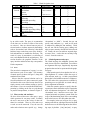
in Table 1. This language has full first-order expressiveness (Lai, 2005), and can be compiled into
SQL for efficient evaluation (Bird et al., 2006).
Here is the translation of the query //A//B into
SQL:
Many useful queries turn out to be simple to express in this path language, owing to the fact that
linguists identify tree nodes and relationships between nodes by reference to structurally local information.
3 Query by Annotation
Query by Annotation is an approach to tree query
in which a user annotates an existing tree – the
“base tree” with a query. The base tree may be
any tree found in the treebank by browsing or