1
that it supports direct annotation of a query on a
tree, displayed in the customary form of a parse
tree.
QBA provides users with several benefits relative to direct use of a path language. First, QBA
provides a high-level interface to a path query language, avoiding the need for users to learn a query
syntax. Second, QBA queries are not created ex
nihilo, but by annotating an object from the domain. Users find it easy to express queries of the
form: “find me more trees that are like this one in
the specified way.” Third, result trees can be automatically overlaid with the original query, which
means that queries and results are of the same
type, namely annotated trees. A user sees why the
query matched, and can edit the annotation to refine the query.
The main contributions of this work are as
follows: a new approach to graphical, semistructured query is presented, in which examples
are annotated with a query graph, and queries
are translated into SQL, and results are annotated
with the original query; an application to linguistic databases is described, motivating and exemplifying the approach; and an implementation is
reported, involving translation steps from an annotated tree to a path language, thence to SQL for
evaluation.
This paper is organised as follows. In Section 2 we review key background topics including
linguistic annotation, corpus curation, and query
by example. In Section 3 we present our approach to query by annotation, and in Section 4
we show how annotated queries are translated into
the LPath language, then in Section 5 we explain
how queries are overlaid on result trees. Section 6
describes a prototype implementation, and Section
7 reports our conclusions.
2 Background
2.1
Linguistic Annotation
Linguistic databases consist of time-series data
together with structured annotations. The timeseries data represents an external linguistic artefact, and takes the form of a text or recording. The
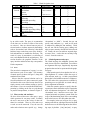
relationship between the primary data and its annotations is shown schematically in Figure 1.
A common data model for linguistic annotations is a labelled, ordered tree. (The nodes of the
tree are ordered, by virtue of the linear ordering of
the time-series data.) A natural candidate for rep-
Figure 1: Linguistic Annotation: Structured Coding of Extents of Time-Series Data (e.g. Character
Data, Audio Data)
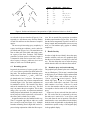
resenting trees is XML, as shown in Figure 2(a).
These structures can be stored efficiently in relational form, using a span-based representation as
shown in Figure 2, following (Bird and Liberman,
2001; Bird et al., 2006).
2.2 Curating Treebanks
Treebanks are typically created over an extended
period. Initial processing is done using a statistical parser, followed by substantial manual editing.
During the course of this activity, highly-specific
annotation conventions are developed; these conventions are further elaborated as new constructions are encountered. Thus, treebank creation involves significant curation work.
A typical part of the curation workflow is for a
linguistically trained annotator to discover an incorrect parse (generated by a statistical parser),
and then try to identify all other occurrences of
the faulty structure and to rectify them as necessary. In the earliest days of treebank development,
such curation was done by editing labelled bracketings in a text file, aided with editing macros and
Perl scripts. Not surprisingly, this approach did
not scale well. A common response has been to
develop a tree query language.
2.3 Querying Linguistic Trees
Many tree query languages have been developed
for parsed corpora, e.g. tgrep, TIGERSearch, fsq,
LSE, Netgraph (Rohde, 2001; König and Lezius, 2001; Kepser, 2003; Resnik and Elkiss, 2003;
Mı́rovský, 2006). For a survey, please see (Lai
and Bird, 2004). Current graphical tree query interfaces permit users to draw partial trees from