1
BASIC Answers to BASIC Questions
VIRTUAL ARRAYS AND RECORD I/0
(Section 10.2-10.14)
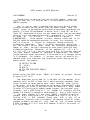
There still exists some confusion about virtual arrays and record I/O.
An example using both of these powerful features should aid in clarifying
their use.
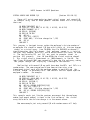
10 OPEN "EMPLOYEE" AS 1
20 FIELD #1, 20 AS NM$, 22 AS Z1$, 2 AS DI$, 64 AS Z2$
30 OPEN "CHANGES" AS 2
40 DIM #2, DV$(999)
50 FOR I=0 TO 999
60
GET #1
70
LSET DI$ = DV$(I)
80
PRINT NM$; " division changed to "; DI$
90
PUT #1
100 NEXT I
This program is designed to mass update the employee's division number of
an employee file stored in record I/O form with a table of division changes
stored as a virtual array. Line 10 OPENs the file EMPLOYEE on channel 1.
Line 20 describes the file's format. Each employee record is a total of
108 bytes long; however, BASIC will use an entire sector (252 bytes) to store
it. The two variables Z1$ and Z2$ are used to preserve spaces to
position DI$ properly.
Line 30 then OPENs the virtual array on channel
2. This virtual array is dimensioned as 1000 elements in line 40. The
loop (lines 50 through 100) goes sequentially down the file and array, making
the proper change and displaying a message to the terminal.
Realize that with record I/O we could have done the GETs and PUTs in a
random order. The same program could have been written using a two
dimensioned virtual array with the employee number in one field and the
division change in the other field. Now the GETs and PUTs depend upon the
employee's number.
For example:
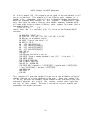
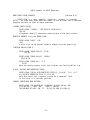
10 OPEN "EMPLOYEE" AS 1
20 FIELD #1, 20 AS NM$, 22 AS Z1$, 2 AS DI$, 64 AS Z2$
30 OPEN "CHANGES" AS 2
40 DIM #2, DV$(350,1)
50 FOR I=0 TO 350
60
GET #1, RECORD CVT$F(DV$(I,0))
70
LSET DI$ = DV$(I,1)
80
PRINT NM$; " division changed to "; DI$
90
PUT #1, RECORD CVT$F(DV$(I,0))
100 NEXT I
This example works just like the previous one except that the employee
number (and record number) is found in the first column of the virtual
array table while the division change is in the second column.
One more example just using record I/O with random access will help
-3-