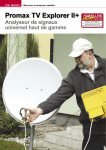
1
or watching TV channel. We
managed to do a blind scan
of a satellite, automatically
measure all its transponders and save the results on
a pendrive hooked up to its
all its possibilities and modes.
We asked for a manual in
English and after a few days,
we got a draft version. Only
then, we realized how much
this meter can do!
USB port. All this based only
on a few pages of a product
brochure in English. That’s
what
we
call
“exploratory
testing”.
Basic
functions
With an analyzer as complex as SPAROS 609, it would
take rather long to discover
SPAROS 609 can practically measure any TV signal.
All analog and digital modes:
satellite, cable and terrestrial. It is compatible with the
following satellite standards:
PAL, SECAM, NTSC, DVB-S,
DVB-S2 and DSS (this one is
used in USA). Its spectrum
analyzer
covers
continuously the band from 45 MHz
to 2150 MHz. So it is obvious
that this meters can do much
more than just show IF satellite signal at the output of an
LNB (950-2150 MHz).
ulation and FEC. Nothing is
missing! DVB-S2 has slightly
different error rate related
parameters: LDPC, BCH and
PER that replace more familiar CBER, VBER and UNC. We
SPAROS measures the following parameters of the DVBS signal: channel power, C/N,
LNB voltage, LNB current,
channel bit error rate (CBER),
Viterbi bit error rate (VBER),
number
of
uncorrected
packet (UNC) and modulation
error ratio (MER). Additional
it displays: transponder frequency,
band/polarization,
standard, symbol rate, mod-
will not describe all DVB-C
and DVB-T parameters but,
believe us, those signals are
measured as extensively as
satellite ones.
Satellite
alignment
Perhaps one of the most
interesting characteristics of
such instrument is its use-
www.TELE-satellite.com — 08-09/2009 — TELE-satellite — Broadband & Fiber-Optic
51