1
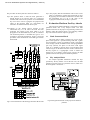
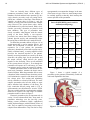
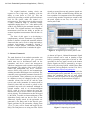
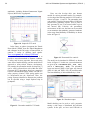
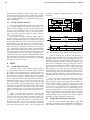
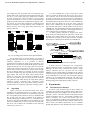
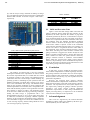
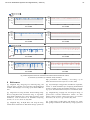
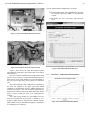
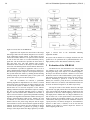
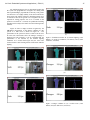
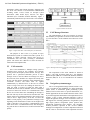
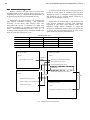
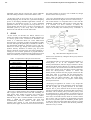
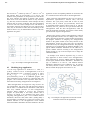
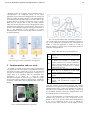
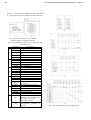
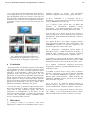
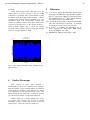
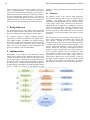
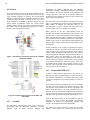
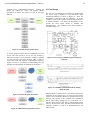
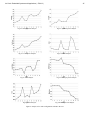
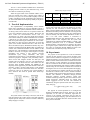
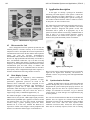
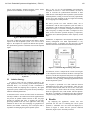
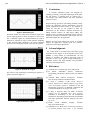
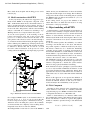
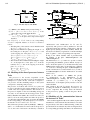
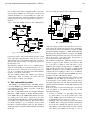
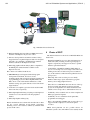
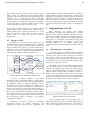
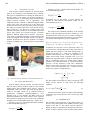
102 Int'l Conf. Embedded Systems and Applications | ESA'12 | 5 Application description In this paper we develop a prototype for biomedical monitoring. The main objective of this system is collect and transmit first-hand bio-signal information to a host for medical tracking and recording when a patient in emergency state within a medical assistance vehicle or when he’s located in other place, far from a medical center. The signals derived from monitoring equipment such as ECG, heart rate, respiratory rate, oxygen saturation and blood pressure should be integrated with patient’s record. This information will be placed in an appropriate way at the patient's electronic medical records using a standard format in order to send it to a remote location through a wireless network whenever the medical staff requires it. Figure 4 illustrates the system functionality and its environment. Figure 3. ADS1298 blocks diagram [10]. 4.2 Microcontroller Unit Due to unsupported real time operations presented by the Android platform, it became necessary to use an auxiliary subsystem in order to accomplish the real time requirements in communication tasks between the host and the data acquisition system. We used the Freescale Semiconductor’s MC9S08JM60 Microcontroller Unit (MCU). It is member of the low-cost, high-performance HCS08 family of 8-bit MCUs, has a Von-Neumann architecture, Up to 60 KB of on-chip flash memory, 4KB of data memory, 24-MHz of internal bus frequency, two full duplex Serial Peripheral Interfaces (SPIs) communication ports, and other variety of modules. SPI communication speed can be established based on the MCU bus frequency and is configurable through control registers, to facilitate communication with a large number of devices. 4.3 Main Display System Android platform is supported by Texas Instrument’s DM3730 processor. The DM37x generation of highperformance, applications processors are based on the enhanced device architecture and are integrated on TI's advanced 45-nm process technology. This architecture is designed to provide best in class ARM and Graphics performance while delivering low power consumption. This balance of performance and power allows the device to support a huge variety of multimedia applications [11]. The DM3730 integrates a GPP (General Purpose Processor) ARM Cortex ™-A8 @1GHz, a DSP (digital signal processor) TMS320C64x @800MHz plus a graphics accelerator 2D and 3D PowerVR SGX 530. The GPP controls all hardware resources using a generic operating system like Linux, Windows CE or, in this case, Android. The DSP acts as coprocessor of GPP. It also integrates various peripherals and interfaces to connect the different types of external devices. Figure 4. System Diagram. Here we focus on ECG signal acquisition process, because this signal has the highest time variability, and therefore, it demands resources for processing tasks and high-bandwidth capability. 5.1 Synchronization Problem Initially, the ADS1298 was directly connected to Blizzard platform through SPI ports in both devices, because it was thought that the system would operate properly. However, the acquired signal did not show the expected behavior. For example, for sinusoidal test waveform, we got a distorted version (Figure 5). Some strategies were implemented trying to fix the problem. The issue was related with the fact that the OS in the Blizzard platform does not support the real-time demands of the application, necessary for the communication. Such a problem becomes more severe when the ASIC operates under continuous conversion mode, because the data acquisition times must be accurately respected, for the sake of ensuring