1
Int'l Conf. Embedded Systems and Applications | ESA'12 |
143
PIC 32 MICROCONTROLLER BASED sEMG ACQUISITION
SYSTEM AND PROCESSING USING WAVELET TRANSFORMS
Chandrasekhar Potluri, Member , IEEE, Madhavi Anugolu, Member, IEEE, Alex Jensen, Girish Sriram,
Shiwei Liu, Steve Chiu, Member, IEEE, Alex Urfer.
Abstract – In this paper, an embedded system platform is used for
signal acquisition and processing. On a healthy male subject, the
motor unit of the ring finger is marked. The surface
Electromyographic (sEMG) signals and their corresponding skeletal
muscle force signals are acquired using a PIC 32 microcontroller at
a sampling rate of 2000 samples per second. The filtration is
achieved by using a Wavelet transform Daubechies 44 filter at 5
levels of decomposition for sEMG and a Chebyshev Type-II filter for
skeletal muscle force signals. The data is acquired through the
Universal Asynchronous Receiver/Transmitter (UART) model of the
PIC 33MX360F512L embedded test bed and is compared to data
acquiredwith standard sEMG Delsys® Bagnoli 16 acquisition
system.
Keywords: sEMG, Wavelet Transforms, Real-time Data Acquisition,
I.
INTRODUCTION
The functioning human body is one of the most intricate
systems available. Similarly, surface Electromyography
(sEMG) signals are quite complex and challenging to analyze.
Currently more than 2 million Americans have an amputation,
and the number of amputees is increasing by approximately
185,000 per year [1]. Research related to upper extremity
prostheses over the recent past has been focused on increasing
function of the user coupled with reducing the psychological
and emotional aftermath of dealing with limb loss. A robotic
prosthetic hand should be autonomous, have a high level of
functionality, comfort and be easy to use [2]. From [3, 4] it is
clear that electromyography (EMG) signals have sereved as a
strong model for prosthetic function. The EMG signal is a
natural means of communication and can be recorded at the
surface of the limb, which is known as surface EMG (sEMG).
Chandrasekhar Potluri is with Measurement and Control Engineering
Research Center (MCERC), School of Engineering, Idaho State University,
Pocatello, Idaho 83209, USA (email : potlchan@isu.edu).
Madhavi Anugolu is with MCERC, School of Engineering, Idaho State
University, Pocatello, Idaho 83209, USA (email : anugmadh@isu.edu).
Alex Jensen is with MCERC, School of Engineering, Idaho State
University, Pocatello, Idaho 83209, USA (email: jensalex@isu.edu).
Girish Sriram is with MCERC, School of Engineering, Idaho State
University, Pocatello, Idaho 83209, USA (email: srirgiri@isu.edu).
Shiwei Liu is with MCERC, School of Engineering, Idaho State
University, Pocatello, Idaho 83209, USA (email: liushiw@isu.edu).
Steve Chiu is with Department of Electrical Engineering and Computer
Science, MCERC, Idaho State University, Pocatello, Idaho 83201 USA
(email: chiustev@isu.edu).
Alex Urfer is with Dept. of Physical and Occupational Therapy, Idaho
State University, Pocatello, Idaho 83209, USA (e-mail: urfealex@isu.edu).
The sEMG is the result of the electrical activity during
skeletal muscle contraction. It ranges between -5 and +5 mV.
The sEMG signals are widely used for the position and force
control of the hand prosthesis [5, 6]. Since the skeletal muscle
force and the sEMG signals are directly proportional, an
increase in force production results in increased sEMG
activity. Therefore, the latter is used as a control input to
realize force and motion control of a prosthetic hand. This
makes the precise interpretation of the sEMG signal an
essential task.
In the present research environment, embedded systems
have become pervasive and as research advances, more and
more functions of analog circuits are being realized by
microcontrollers, Analog to Digital Converters (ADCs) and
Digital to Analog Converters (DACs). In a modern control
system, data acquisition, processing and control functions are
performed by embedded systems. A well-designed embedded
control which deals with widely varying operating conditions
can realize excellent system performance. The embedded
system should be designed carefully in order to have a robust,
precise, fast and consistent performance.
In our previous work [7-9], we implemented a real-time
embedded control system to control the force and motion of a
prosthetic hand. The present work is a step ahead in the same
direction where the authors explore the PIC 32
microcontroller as an embedded platform to simultaneously
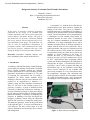
acquire the sEMG and skeletal muscle force. sEMG sensors
are placed on the ring finger motor point of the dominant
hand of a healthy subject and the subject is asked to squeeze a
stress ball which has a force sensing resistor attached to it.
The data is simultaneously captured using the PIC 32
embedded platform with MATLAB®/SIMULINK® real-time
workshop (RTW) and regular NI LabVIEW™ data
acquisition. Both sEMG and force data is captured at 2000
Hz. The sEMG signal is filtered using four different types of
filters nonlinear Bayesian filters: Exponential, Poisson, and
Half-Gaussian filter and wavelet transforms Daubechies 44
filter. The corresponding skeletal muscle force is filtered by a
Chebyshev type-II filter [8]. Among these different types of
filters the wavelet Daubechies 44 filter is giving the best
results [10-15].
This paper is organized as follows: the present section is
followed by the „Experimental Set-Up,‟ then the „Signal PreProcessing,‟ „Methodolgy‟, „Results and Discussion,‟ are
presented. The paper is concluded with the section of
„Conclusion and Future Work.‟