1
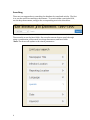
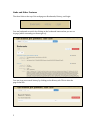
Executive Summary This report includes a detailed description of Dr. Ewing’s Russian Flu project. This project integrated two groups: a Translation team and a CS team. The translation team worked to find and translate historical articles documenting the Russian Flu pandemic from 1889 to 1890. The languages consisted of French, German, Spanish, English and Russian. The CS team indexed the article metadata into a searchable website. The desired website allowed a user to search for articles, view a list of corresponding results, and understand the specifics of a given article. The website was implemented using Solr, an open-‐source search engine platform and Blacklight, a Ruby on Rails gem. Solr’s search features included facets, relevance definitions, spell checking, and synonyms. Blacklight was easily integrated with Solr, in that it displayed the search features and results in a user-‐ friendly format. Blacklight was configured with a faceted search, drop-‐down menu search, full-‐text search box, and spell checker. The facets defined for the Russian Flu project included Newspaper Title, Infection Location, Reporting Location, Language, Date, and Keywords. Once a facet is specified, a search is executed, or a combination of the two, a list of corresponding results is displayed. The metadata associated with each article can be viewed as a single document through clicking the Newspaper Title link. The website also includes multimedia resources tracking the Russian Flu pandemic. An interactive timeline depicts a world map with the flu outbreak and spread at different time intervals. Another multimedia resource is the Google Earth 1889 Russian Flu map overlay. This interactive Google Map allows a user to see all continents and the flu’s impact through an 1889 world map. The Russian Flu website also has a user log in, search history, and article bookmark feature. A user can bookmark an article upon viewing it as a single document. When logged in, a user can view a full list of bookmarked articles. The search history feature saves a list of the user’s recent searches, and at the click of a button, the search executes again. Various problems were encountered throughout the semester, the largest being the lack of a server until April. This kept us from integrating Solr and Blacklight until access to a server was granted. Communication lacked amongst the CS and translation teams, in that the CS team relied on the translation team to format the data correctly in order to index it into Solr. Our client, Dr. Ewing, hopes to continue the Russian Flu project in the future as well as extend the website’s functionality. Articles will continue to be translated and article data will continue to be indexed. 2