1
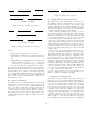
open javax.swing java.awt java.awt.event
_classtype SampleApplet () : JApplet ()
with local
val prefix = "Counter: "
val count = ref 0
val label = JLabel(prefix ^ "0", JLabel.CENTER)
fun makeButton (title, increment) =
let
val button = JButton (title:string)
val listener =
ActionListener ()
with
actionPerformed(e : ActionEvent option) =
(count := !count + increment;
label.#setText(prefix ^ Int.toString(!count)))
end
in
button.#addActionListener(listener);
button
end
in
init () =
let
val SOME pane = this.#getContentPane ()
val button1 = makeButton ("Add One", 1)
val button2 = makeButton ("Add Two", 2)
in
pane.#add(button1, BorderLayout.WEST);
pane.#add(label, BorderLayout.CENTER);
pane.#add(button2, BorderLayout.EAST);
end
end
use and definition of Java interfaces, and the formalisation
of certain aspects.
2
Design goals
We wanted ML code to be able to read and write external Java fields, call external Java methods and treat external Java objects in a first-class way – storing them in ML
data structures, passing and returning them from ML functions. We also wanted ML code to be able to define new
Java classes which extend existing external classes (and implement external interfaces) with methods written in ML.
These classes should be accessible and usable either from
within the ML program or by other external Java code.
In addition to these basic goals, we wanted the interface
to have a certain ‘flavour’. At first we took the view that
the interface could be slightly ugly when compared with ML
itself, as it would only be used by library-writers to provide
a functional wrapper around an existing Java package; indeed, the strangeness of any new syntax would serve as reminder that the programmer was doing something reserved
for experts. However, once we discovered how useful and
pleasant it was to have straightforward, safe interoperability with Java’s standard library code and third-party Java
applications (and sometimes even to develop new mixedlanguage applications from scratch), we began to think that
this should be made as convenient and natural as possible.
Therefore in the most recent version of the foreign-language
interface we have aimed to provide:
• Simplicity: the syntax used to access Java classes and
to create new ones should be as lightweight as possible so that a programmer can use it without to much
of a mental context-switch. To attain simplicity as
many ML concepts as possible were re-used (for example, packages are identified with structures and subpackages with substructures) but this was done only
where it makes sense semantically (for example, static
methods are like ML functions but non-static (virtual)
methods are not).
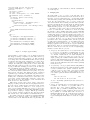
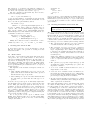
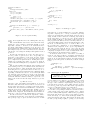
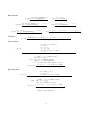
Figure 1: A sample applet in MLj
Java.fromInt or Java.toInt coercion, which would actually disappear during compilation because ML’s int is represented as Java’s int in the compiled code. The extensions
for creating classes from within ML included new keywords
for all Java class and method attributes, even where these
overlapped conceptually with existing ML concepts. For
example, the namespace management of Java’s static final
fields and static methods provided by classes overlaps the
scoping of ML value bindings provided by the module system, and mutable fields are similar to ML refs.
Experience with the MLj 0.1 extensions showed that they
were extremely useful, but that there was plenty of scope for
improvement. Amongst other things, the strict separation
of primitive types was unnecessarily annoying, there was too
much baroque syntax associated with the embedding of Java
in ML (some of which was rarely used because there were
better ways of using existing ML constructs to achieve the
same effect) and one often wished to treat Java fields and
methods in a more first-class way.
This article describes the revised design of the interlanguage working extensions that is being implemented for
the next version of MLj and the rationale for that design.
The new extensions are much more of an integration of
Java concepts within ML than an interface between the
two languages, though for compatability with SML, we have
stopped short of trying to design a fully-fledged ‘natural’
object-oriented extension of ML. We also sketch a formalisation in the style of the Definition of Standard ML [13].
We assume a knowledge of ML and a passing familiarity
with Java. Note that for clarity of presentation we omit
certain features of the ML-Java interface, in particular, the
• Compatibility: correct programs written using SML’97
should typecheck and execute without alteration. This
severely constrained the syntax extensions that we
could use, but we believe that our design is tasteful
and unobtrusive. We have not quite managed to preserve all the equations which hold in SML’97 since, for
example
("h"^"i","h"^"i")
let val x="h"^"i" in (x,x) end
and
are not contextually equivalent (as Java can check object identity).
• Safety: one pleasant aspect of Java is that type safety
is built-in. In contrast to C, programs cannot corrupt the store, leave pointers dangling, and so on.
However, ML goes further, insisting that values are
bound explicitly at their definition, whereas in Java
the possiblity of a default null value can lead to a
NullPointerException. To retain the spirit of ML, we
are quite strict about values of Java class and array
types, insisting that null values are checked for explicitly.
2