1
Virginia Finca, Radu Zglimbea,
Emilian Greaban, Constantin Marin
WSEAS TRANSACTIONS on SYSTEMS and CONTROL
[
](
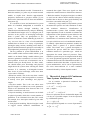
The operator (3), whose class can be determined,
represents a family of models with a given structure
wi (t ) = ∑ Ψi j (u (t ), y (t ))
realization of the model if the function
ν (t ) = ∑ [Ψ0j (u (t ), y (t ))]
pi
(5)
is the zero function,
qθ / (u , y ) = 0
(6)
*
*
*
*
that means,
qθ / (u
*
*
, y*
(
)
*
*
*
) (t ) = Q u (t ), y (t ), θ = 0, ∀t ∈ E
(t ) = Q(u (t ), y(t ),θ * ) = 0, ∀t ∈ i, ∀(u, y )∈ Ω × Γ
output pair (uT , yT ) ,
(9)
θˆ = θˆ(uT , yT , Q )
(17)
(10)
in a such a way that,
qθˆ / (u , y ) (t ) = 0, ∀t ∈ E
(18)
T
qθˆ / (u , y ) (t ) = 0, ∀t ∈ E , ∀(u , y ) ∈ Ω × Γ
system. As the unknown parameter θ has a finite
number p of components, then it will be enough to
represent a sum of the
choose (utilize) a finite number N of time instants,
ti , i = 1 : N based on which to create an algebraic
derivatives of some known, possible nonlinear,
functions Ψi , Ψ , with respect to the input and
j
0
(12)
equation. In the specific case of (11), this is a linear
system
(20)
Wθ = v
Where W is a N × p matrix of real numbers,
(13)
W = w(t1 ) ;...; w(ti ) ;...; w(t N )
output variables,
pi
[
](
wi = ∑ Ψi j (u , y )
ni j
)
, i = 1: p
j =1
ν = ∑ [Ψ0j (u , y )]
(n )
p0
j
0
[
j =1
Parameters
pi , nij , p0 , n0j
are
given
integer
(22)
]
v = [v(t1 ),..., v(ti ),..., v(t N )]
(23)
unique solution is obtained,
−1
θˆ = (W T W ) W T v = θ *
(24)
Let us denote r = rank (W ) . If r = p , then a
(14)
i =1
The equation (24) is of no practical interest
because it is not recommended to measure (or to
estimate) the derivatives of signals, mainly when
]
w T (t ) = w1 (t ), ..., wi (t ), ..., w p (t )
ISSN: 1991-8763
Whose i-th row ( i = 1 : N ) is,
w(ti ) = w1 (ti ),..., wk (ti ),..., w p (ti )
T
T
p
[
(21)
T
The symbol v denotes a N column real vector,
value of the function qθ / (u, y ) (t ) is a real vector
where
]
T
[
numbers. The identification problem, into condition
(11), has a unique solution. At any time instant t, for
a measured input-output pair of functions (u, y ) the
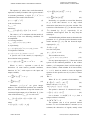
qθ / (u , y ) (t ) = ∑ wi (t )θ − ν (t ) = w T (t )θ − ν (t )
(19)
For any input-output pair (u , y ) observed to that
(11)
i =1
j
T
This condition involves,
p
Where wi and ν
respectively. If no
model structure Q , (3), and the observed input-
A special case is the model (3) expressing a
linear relation in the parameters
qθ / (u , y ) = Q(u , y ,θ ) = ∑ wiθ −ν = wT θ − ν
(16)
confusion would appear, then we may drop the
subscript T .
An identification problem means to determine the
parameter θ = θˆ , given the priori information on the
2. Uniqueness condition
qθ / (u , y ) (t ) = 0, ∀t ∈ i, (u , y ) ∈ Ω × Γ ⇒ θ = θ *
j
0
(uT , yT )
T is denoted by
(7)
or, equivalently,
/ (u , y )
(15)
Practically, it is possible to record the functions
(u, y) in the time interval T ⊂ E only, called
observation time interval or just time window. The
restriction of the functions (u, y ) to the time interval
*
*
(n )
p0
The value θ = θ * is consistent with the model (5)
if and only if the two following conditions are
accomplished:
1. Covering condition
(8)
qθ / (u , y ) = Q (u , y ,θ * ) = 0, ∀(u , y ) ∈ Ω × Γ
qθ
, i = 1: p
j =1
qθ / (u , y ) = Q (u * , y * ,θ * )
*
)
j =1
in constant parameters. A triple (u * , y * , θ * ) is a
*
nij
457
Issue 9, Volume 4, September 2009