1
Virginia Finca, Radu Zglimbea,
Emilian Greaban, Constantin Marin
WSEAS TRANSACTIONS on SYSTEMS and CONTROL
unstructured time-domain models. Unstructured or
black-box models [1,3] often rely on neural network
models to exploit their function approximation
properties. Structured or gray-box models [5] are
based on the interconnection of linear and nonlinear
subsystems [2].
It is essential to ‘know and understand’ a system
before it is handled, manipulated or controlled. A
system is known through modeling and
identification and understood by analysis. Modeling
and identification happen to be a conjugate pair of
activities in the process of developing knowledge
about a system. They are prerequisites to the
practice of automatic control. Modeling by itself is a
very vast area rich in a host of well-established
methods that are based on a variety of principles.
Among the many variants, modeling on the basis of
physical unified framework principles can hardly be
overemphasized, particularly for physical systems.
The key problem in system identification is to
find a suitable model structure within which a good
model is to be found. Fitting a model within a given
structure (parameter estimation) is in most cases a
lesser problem. A basic rule in estimation is not to
estimate what you already know. In other words,
one should utilize prior knowledge and physical
insight about the system when selecting the model
structure. It is customary to distinguish between
three levels of prior knowledge, which have been
‘color-coded’ as follows.
• White-box models. This is the case when a model
is perfectly known; it has been possible to construct
it entirely from prior knowledge and physical
insight.
• Gray-box models. This is the case when some
physical insight is available, but several parameters
remain to be determined from observed data. It is
useful to consider two sub cases.
1. Physical modeling. A model structure can be built
on physical grounds, which has a certain number of
parameters to be estimated from data. This could,
for example, be a state-space model of given order
and structure.
2. Semi physical modeling. Physical insight is used
to suggest certain nonlinear combinations of
ISSN: 1991-8763
measured data signal. These new signals are then
subjected to model structures of black-box character.
• Black-box models. No physical insight is available
or used, but the chosen model structure belongs to
families that are known to have good flexibility and
have been ‘successful in the past’.[3]
Obviously, a large number of dynamical systems
encountered in practice are both continuous in time
and nonlinear. Moreover, identification of
continuous-time systems from available sampled
input-output data records is desirable to enhance the
interpretation of the dynamical system behavior and
to support the controller design. Clearly, the
identification of continuous-time nonlinear systems
is a topic which has received considerable attention.
To identify a plant based on parametric models one
requires either a general or a special nonlinear
model. The former uses a general description to
represent the process while the latter considers
nonlinear models of a particular type which are
appropriate for certain classes of processes. Thus,
nonlinear systems may be investigated with the help
of a series polynomial expansions approach, such as
a Hammerstein model. The Hammerstein model is a
nonlinear model which describes a special class of
system nonlinearities, and it can be represented by
the series interconnection of a static nonlinear
element followed by a linear dynamic model.
2 Theoretical Aspects Of Continuous
Time Systems Identification
Let us consider a dynamical continuous time
system with nu inputs,
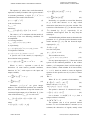
u : E → E n , t → u (t ), u ∈ Ω
u
(1)
and n y outputs,
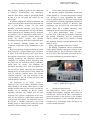
y:E → E
n yu
, t → u (t ), u ∈ Γ
(2)
where Ω represents the set of admissible inputs and
Γ is the set of possible outputs. It can be expressed
by a differential operator,
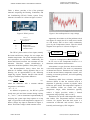
qθ / (u , y ) = Q(u , y , θ )
(3)
whose expression depends on a vector of parameters
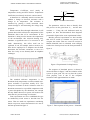
θ = [θ 1 ...θ i ...θ p ]
T
456
(4)
Issue 9, Volume 4, September 2009