1
Virginia Finca, Radu Zglimbea,
Emilian Greaban, Constantin Marin
WSEAS TRANSACTIONS on SYSTEMS and CONTROL
Temperature Coefficient, used mostly in
temperature sensing and PTC-Positive Temperature
Coefficient, used mostly in electric current control.
A thermistor is a thermally sensitive resistor that
exhibits a change in electrical resistance with a
change in its temperature. The resistance is
measured by passing a small, measured direct
current through it and measuring the voltage drop
produced.
When a current flows through a thermistor, it will
generate heat which will raise the temperature of the
thermistor above that of its environment. If the
thermistor is being used to measure the temperature
of the environment, this electrical heating may
introduce a significant error if a correction is not
made. Alternatively, this effect itself can be
exploited. It can, for example, make a sensitive airflow device employed in a sailplane rate-of-climb
instrument, the electronic variometer, or serve as a
timer for a relay as was formerly done in telephone
exchanges.
T
[ C]
Time
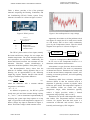
Figure 5. Sensor Characteristic
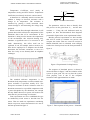
The parameters witch we have to identify from
this process are the gain factor k rp _ r and the time
constant τ r . Using the soft dedicated made by
Quanser we have had determined from diagrams
presented in figure below some experimental values:
Besides practical experiments we had consider
that will be useful to simulate our process and
compare the results. Thus we create his version in
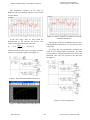
Matlab Simulink and we obtained some edifying
results.Our virtual process has the form presented in
figure 6.
Figure 6. Experimental Cooling Process
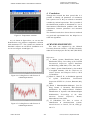
The response of simulated process is shown in
what will follow in figure 7 and the evolution of the
system is quite good. We can say that the system
work properly even if due to the computer
truncation some approximations are made.
The standard reference temperature is the
thermistor body temperature at which nominal zeropower resistance is specified, usually 25°C. The
zero-power resistance is the dc resistance value of a
thermistor measured at a specified temperature with
a power dissipation by the thermistor low enough
that any further decrease in power will result in not
more than 0.1 percent change in resistance
From experiments we have established the type
on nonlinearity witch seems to describe best our
sensor. Thus we made our experiments considering
that in our process sensors characteristics it is one of
the form presented in figure 5.
ISSN: 1991-8763
Figure 7. Time response of real process – Simulink
461
Issue 9, Volume 4, September 2009