1
Dynamic frequency-warping of a filter can also yield interesting and pleasing results by allowing
the adjustment of one parameter to change the entire frequency response of a complex filter, much
as adjusting "Frequency Cutoff" can sweep a resonant low pass filter to pleasing effect.
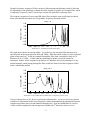
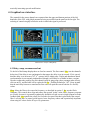
The frequency responses of two warped IIR lattice filters using the same coefficients are shown
below (note that the horizontal axis is logarithmic frequency measured in kHz).
Warp = 0
150
Magnitude (dB)
100
50
0
−50
−100
−150
−200
0.02
0.05 0.1 0.2
0.5
1
2
5
10
22
Illustration 1: A random unwarped lattice filter
The graph above shows an unwarped filter. As can be seen, the unwarped filter has most of its
spectral peaks in the region between 2kHz and 22kHz. What this means is that if you fed a plucked
guitar string sound (A2, 110Hz for example) through the filter, then it wouldn't be until its 10th
harmonic (at 10 x 110Hz = 1.1kHz) that any interesting frequencies would be boosted or
attenuated. Further, all the frequencies up until the 10th harmonic are heavily attenuated, so any
natural harmonic sound passing through the filter would lose almost all of the frequencies which
make it identifiably musical.
Warp = 0.9
150
Magnitude (dB)
100
50
0
−50
−100
−150
−200
0.02
0.05 0.1 0.2
0.5
1
2
5
10
22
Illustration 2: The random filter of Illustration 1 warped by a factor of 0.9
Using a warping factor of 0.9, however (pictured in Illustration 2), we can see how more spectral
resolution is concentrated on the lower frequencies where the human hearing apparatus has greater
resolution and where more relevant timbral information lies. Now the fundamental of a note at
110Hz would be emphasized, and starting around 500Hz (the 5th harmonic), there's a lot of
-2-