1
Frame3DD User Manual
http://frame3dd.svn.sourceforge.net/viewvc/frame3...
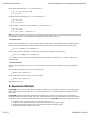
Uniformly distributed static loads may be applied in the local element coordinate system over the entire length of a
frame element. Uniformly distributed loads are specified as values of the load per unit length applied to the frame
element in the local x direction, the local y direction, and the local z direction.
Frame Element Point Loads
Concentrated static force loads may be applied to frame elements between the joints. Up to ten frame element point
loads may be specified per frame element. These loads are specified as values of point forces applied to the frame
element in the directions of the frame element's local coordinate system at a distance x from joint J1 of the frame
element.
Trapezoidally-Distributed Loads
Trapezoidally distributed loads may be applied over a partial span of frame elements. Up to ten trapezoidal loads may
be specified per frame element. Trapezoidally distributed loads have components in the local x direction, the local y
direction, and the local z direction. Trapezoidally distributed loads are specified by the distances along the local
x-axis where the loading starts and stops, and by the value of the load at the starting location and the stopping
location.
The starting location for a trapezoidal load must be greater than 0 and less than the stopping location of the
trapezoidal load. The stopping location for a trapezoidal load must be greater than the starting value of the
trapezoidal load and less than the length of the frame element. Fixed end forces computed from trapezoidal loads
include the effects of shear deformation when shear deformation effects are incorporated.
Thermal Loads
Thermal loads assume a linear temperature gradient through cross sections. Thermal loads are specified by values for
the coefficient of thermal expansion, the depth of the section in the local y direction, the depth of the section in the
local z direction, and the temperature changes on the +y surface, the -y surface, the +z surface, and the -z surface.
Thermal loads are applied over the entire frame element.
Prescribed Displacements
Static joint displacements and rotations may be prescribed only at reaction degrees of freedom. Static joint
displacements and rotations are specified in the structure's global X-Y-Z coordinate system.
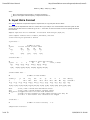
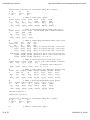
Up to thirty static load cases may be anlayzed by specifying the variable nL in the Input Data file, and by specifying the
seven types of loads for each load case, as shown in Frame3DD example A and Frame3DD example B.
More than one load of the same type on the same element or joint may be specified. For example, one or more
trapezoidally distributed loads may be applied to the same frame element in the same load case.
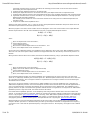
Whenever the average axial strain in a frame element connection (Nx/(EAx)) exceeds 0.001 (0.1%) in magnitude, a warning
message is displayed indicating the strain level and the element in question. Most structural materials yield at strains
between 0.1% and 0.2%. When this warning message is displayed the structure is likely in an overloaded condition and the
loads should be reduced. Note that this check for overloaded elements provides an approximate stress check. A more
complete stress check would compute the composite axial, shear, torsion and bending stresses and strains within each
element. Such a check requires additional cross section information: the section moduli and the section dimensions, as
described in sections 7.13 and 7.14 below.
The static stability of many structures depends upon a level of prestress within the structure. In such goemetrically
non-linear analyses, pre-stressed structres may be modeled by specifying a uniform temperature cooling in all pre-tensioned
elements. The value of the temperature change corresponding to a desired pre-stress tension force depends on the stiffness
of the components of the structural system and may be determined with a few iterations. As an initial guess, set the
temperature change to be (-T)/(a E Ax), where T is the value of the desired pre-stress tension of the frame element, a is the
coefficient of thermal expansion, E is the elastic modulus, and Ax is the cross section area of the frame element. Section 8,
below, describes how thermal (pre-stress) loads are analyzed before the response to mechanical loads is analyzed.
7.10 Dynamic Modal Analysis
The Frame3DD analysis will optionally include a dynamic analysis for natural modes of vibration. Dynamic properties may
be obtained for the un-stressed or the stressed structure by either neglecting or including geometric stiffness effects. The
mass may be modeled using either the consistent mass matrix or the lumped mass matrix.
The natural frequencies and mode-shapes of the structural frame may be computed from the stiffness and mass matrices
using either the Stodola method or the Jacobi method. The solution method and the convergence tolerance for these
iterative methods is specified in the Input Data file. If a dynamic modal analysis is to be carried out, the Input Data file must
also specify the mass density of each frame element, additional mass carried by the frame element, and extra mass or
inertia carried by the joints. A specified set of modes may be animated within Gnuplot.
Frame3DD has the capability of computing the natural frequencies and mode-shapes of frames that are fully restrained,
partially restrained, or completely un-restrained. Partially restrained frames have up to six independent rigid body modes. A
completely un-restrained frame has six independent rigid body modes. The stiffness matrix for partially restrained and
completely unrestrained structures is not invertible. Such structural configurations can not carry static loads. Furthermore,
the numerical methods used in computing the natural frequencies and mode shapes presume that the stiffness matrix is
invertible. A numerical trick called "frequency shifting" overcomes this difficulty. Presuming the mass matrix [M] is
invertible, and given a sufficiently large positive scalar value s, the matrix [[K] + s[M]] is invertible, even if the stiffness
18 of 33
11/09/2010 11:18 AM