1
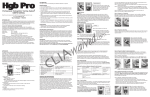
Step 8: Apply Blood Sample to the Test Strip
Immediately add a drop of blood to the test strip by
touching the hanging blood drop to the test spot. (Make
sure the blood drop is large enough to completely
cover the test spot.) A capillary transfer pipet may
also be used to transfer the blood sample from the
finger to the test strip.
Tips for applying a fingerstick blood sample to the
meter:
• A single blood drop of at least 15µl of blood must
be applied.
• DO NOT remove the test strip to apply the blood
sample – the test strip must stay inserted in the
meter. The meter may be lifted to the patient’s
finger for blood application.
• DO NOT touch the finger directly to the test spot
membrane.
• DO NOT overfill the test spot – add enough blood
to completely fill the test spot only.
• DO NOT add more blood once blood has already
been applied to the test spot.
Note: If a sample is obtained from a venipuncture, apply
a blood drop (free of bubbles) to the test spot from the
syringe opening or needle. Do not touch the syringe
opening or needle directly onto the test spot.
Step 9: Read Result
The blood sample will spread and the meter will
automatically begin the test. While the test is in
progress, do not disturb or move the meter or test strip,
or press any of the meter buttons.
The result will be displayed as hemoglobin units (as
defined in SET-UP OPTIONS in the User’s Manual) in
either g/dL or mmol/L in less than 30 seconds. The test
result will be displayed for 2 minutes after test
completion.
Accuracy
The clinical performance of the Hgb Pro Professional
Hemoglobin Testing System was evaluated with venous
samples collected from 4 physician office sites and 1
hospital site, as shown in Figure 1. Populations
consisted of adults, neonates and pediatric patients.
Specimens were split for testing on the Hgb Pro and the
Coulter MD8. Correlations for the individual populations
and combined are shown:
Figure 1
Adult
Neonate
Pediatric
Neonate/Pediatric
Combined
n
162
26
38
64
226
Slope
1.049
0.984
0.962
0.988
1.005
Intercept
-0.885
-0.156
0.042
-0.248
-0.371
r
0.982
0.987
0.944
0.988
0.985
LIMITATIONS
1. Plasma or serum cannot be used with the Hgb Pro
Professional Hemoglobin Testing System. Use of
arterial whole blood has not been evaluated.
2. Use of sodium citrate and dried heparin are not
recommended.
INTERFERING SUBSTANCES
During clinical studies, a number of patients had
identified elevated levels of bilirubin, cholesterol and
triglycerides. The interferences of these substances
were assessed using the interpretive guidelines of
NCCLS Guidance Document EP7-A, Interference
Testing in Clinical Chemistry: Approved Guideline7.
There was no demonstrated interference of these
substances on the hemoglobin determination in these
analyses. No interference was observed at upper
threshold concentrations of bilirubin 20 mg/dL,
cholesterol 450 mg/dL and triglycerides 750 mg/dL in
supportive laboratory "spiking studies.”
QUALITY CONTROL
A quality assurance program is recommended to assure
the user of reliable performance of the Hgb Pro
Professional Hemoglobin Testing System. Liquid quality
control testing should be performed upon receipt of a
new lot of test strips and once per every 3 months of
test lot usage.
After test is completed, remove the test strip and
dispose according to standard methods for biohazard
control. The meter will automatically shut off after 2
minutes of inactivity, or can be turned off by pressing the
button. The test result will be stored automatically
with its date and time stamp upon meter shutoff. The
meter must be reset (shut off, restart) between each
test.
Test results can be tagged, viewed or erased. Follow
instructions under TAG, VIEW AND ERASE TEST
RESULTS in the Hgb Pro User’s Manual.
REPORTABLE RANGE
The reportable range for the Hgb Pro Professional
Hemoglobin Testing System is from 4.0 g/dL to 24.0
g/dL. Results under 4.0 g/dL and over 24.0 g/dL will be
displayed as “Lo” and “Hi” respectively to indicate out of
range results.
PERFORMANCE CHARACTERISTICS
Linearity
The linearity of the Hgb Pro System was tested using
one lot of Hgb Pro strips and 7 hemoglobin
concentrations prepared from a single normal donor.
Multiple Hgb Pro instruments (n=5) were tested twice at
each concentration. The data were analyzed using the
NCCLS guideline EP6-A "Evaluation of the Linearity of
Quantitative Analytical Methods"5. The Hgb Pro
Hemoglobin Testing System is linear between 4.0 g/dL
to 24.0 g/dL within 5% of the estimated linear regression
line at a 95% confidence level. The linearity regression
curve is: Y=0.974x+0.264, r=0.99.
Commercially available control material can be used for
this purpose. The Streck Laboratories® PARA 4®
Hematology Control is recommended (phone 800-8430912 or website www.streck.com). The Streck PARA 4
Hematology Control product (catalog # 215110) consists
of Normal, Low Abnormal and High Abnormal levels.
Storage requirements, expiration dating and acceptable
performance ranges for the control material with the
Hgb Pro meter should be obtained from this product’s
package insert. Instructions for use of the Para 4
Control are as follows:
Step 1: Allow the PARA 4 control vials to come to
room temperature prior to use. Prepare the
meter and test strip as instructed in Steps 1,
2, 4 and 5 under TEST PROCEDURE
above.
Step 2: Mix the vial using end-to-end inversion until
the red blood cells are completely
suspended. Do not shake or mix
mechanically.
Step3: Remove the vial cap and discard the first
drop of the control material. Apply one drop
of control material; make sure the test spot is
completely filled (do not touch the test spot
membrane with the vial tip). The test will
begin automatically.
Step 4: The Hgb Pro meter will display the result
upon test completion. Compare the
displayed result to the range indicated on
the PARA 4 package insert. Record result.
Note: Streck control ranges are provided in g/dL. The
g/dL unit can be converted to mmol/L by dividing the
g/dL value by 6.45.
REFERENCES
Precision studies
The total precision of the Hgb Pro Professional
Hemoglobin Testing System was calculated from testing
of commercial controls on multiple days. The Hgb Pro
System was tested repeatedly for 20 days with
commercially available controls as per NCCLS
Document EP5-A6. The testing for the protocol
evaluated three levels of commercial controls in four (4)
instruments with two lots of Hgb strips. The data in
Table 1 was obtained for within run and total precision of
the Hgb Pro System.
Table 1
Precision
Mean
SD
%CV
Level I (n=80)
Within Total
6.86
6.86
0.17
0.18
2.41
2.66
Level II
Within
11.33
0.20
1.73
(n=80) Level III
Total Within
11.33 15.63
0.25
0.18
2.17
1.14
(n=80)
Total
15.63
0.29
1.86
Additionally, precision of the Hgb Pro system was
calculated from testing of freshly prepared whole blood
controls created to specified hemoglobin concentrations.
Samples were prepared from normal donor blood
hemodiluted or hemoconcentrated to manipulate
hemoglobin concentration. Multiple Hgb Pro
instruments were tested repeatedly for 3 days. The
hemoglobin levels of the daily-prepared controls were
confirmed with the Coulter Laboratory instrument
(Beckman Coulter, Fullerton, CA) and are shown in
Table 2 as “Range.” Three levels of venous whole
blood samples were tested with 5 instruments each day.
Over the 3 days, a total of 9 instruments and 3 unique
lots of strips were evaluated. Precision across strip
lots, instruments and days is shown in Table 2.
Table 2
Range
Mean
SD
%CV
N
Level I
6.0 - 6.4
6.30
0.14
2.25
87
Level II
13.0 - 13.4
13.44
0.32
2.35
90
Level III
19.4 - 19.9
19.88
0.39
1.97
90
1. Vengelen-Tyler, V. ed. Technical Manual, 13th Ed.
Bethesda, MD: American Association of Blood Banks.
1999: 753-754.
2. Neuberger, A. and E.L. Tatum, Ed. Frontiers of
Biology, North-Holland Publishing Co. 1970, p.18.
Hemoglobin and Myoglobin in their Reactions with
Ligands, Antoini, E. and M. Brunori.
3. NCCLS Document H4-A4, Procedures for the
Collection of Diagnostic Blood Specimens by Skin
Puncture.
4. NCCLS Document H3-A5, Procedure for the
Collection of Diagnostic Blood Specimens by
Venipuncture.
5. NCCLS Document EP6-A, Evaluation of the Linearity
of Quantitative Measurement Procedures: A Statistical
Approach.
6. NCCLS Document EP5-A, Evaluation of Precision
Performance of Clinical Chemistry Devices.
7. NCCLS Document EP7-A, Interference Testing in
Clinical Chemistry.