1
• No: The AP transmits data using an 800 ns guard interval.
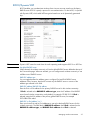
STBC mode
This setting is available only if the selected radio mode includes 802.11n.
Space Time Block Coding (STBC) is an 802.11n technique that improves the reliability of data
transmissions. The data stream is transmitted on multiple antennas so the receiving system has a
better chance of detecting at least one of the data streams. Enabling STBC results in a lower
but more stable throughput.
Select one of the following options:
• On: AP transmits the same data stream on multiple antennas at the same time.
• Off: The AP does not transmit the same data on multiple antennas.
Protection
The protection feature provides rules to guarantee that 802.11n and 802.11g transmissions do
not cause interference with legacy stations or applications. By default, these protection
mechanisms are enabled (Auto). With protection enabled, protection mechanisms will be
invoked if legacy devices are within range of the AP.
You can disable these protection mechanisms (Off). When protection is off, however, legacy
clients or APs within range can be affected by 802.11n transmissions. Protection is also
available when the mode is 802.11b/g. When protection is enabled in this mode, it protects
802.11b clients and APs from 802.11g transmissions.
Note
This setting does not affect the ability of the client to associate with the AP.
Beacon interval
Beacon frames are transmitted by an AP at regular intervals to announce the existence of the
wireless network. The default behavior is to send a beacon frame once every 100 milliseconds
(10 per second).
Enter a value from 20 to 2000 milliseconds.
DTIM period
Specify a DTIM period from 1 to 255 beacons.
The Delivery Traffic Information Map (DTIM) message is an element included in some beacon
frames. It indicates which wireless clients, currently sleeping in low-power mode, have data
buffered on the AP awaiting pickup.
The DTIM period you specify indicates how often the clients served by this AP should check for
buffered data still on the AP awaiting pickup.
The measurement is in beacons. For example, if you set this field to 1, clients will check for
buffered data on the AP at every beacon. If you set this field to 10, clients will check on every
10th beacon.
Fragmentation threshold
Specify a number from 256 to 2,346 to set the frame size threshold in bytes.
The fragmentation threshold is a way of limiting the size of frames transmitted over the network.
If a frame exceeds the fragmentation threshold you set, the fragmentation function is activated
and the frame is sent as multiple 802.11 frames.
Radio configuration
55