1
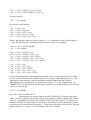
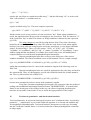
(”<well>”
(”well” N NOM SG (@SUBJ @OBJ))
(”well” ADV (@ADVL)))
Syntactic constraints are not obligatory. They may be omitted or represented as NIL.
13.
Heuristic syntactic constraints
For reasons stated in section 11, the possibility is offered of using heuristic syntactic constraints
in addition to the ordinary syntactic constraints. Heuristic syntactic constraints obey precisely the
same formalism as ordinary syntactic constraints (see section 12) and are declared in the
constraint file after the designated word HEURISTIC-SYNTACTIC-CONSTRAINTS. Heuristic
constraints may be omitted or represented by NIL.
After a heuristic syntactic constraint has applied, all ordinary syntactic constraints
are rechecked on the remaining syntactic ambiguities. Only then further heuristic syntactic
constraints are invoked. This practice maximizes parsing security.
14.
Morphological heuristics
A word-form is unanalyzed if no readings are assigned to it by the morphological analyzer, e.g.:
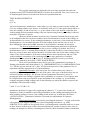
(”*f*b*i”)
This is a cohort containing just a word-form. Heuristic morphological rules may be stated for
assigning features to unanalyzed words. These rules are listed under the designated word
MORPHOLOGICAL-HEURISTICS. The absence of such rules is representable as omission or
NIL.
Heuristic morphological rules are invoked by the option ”+” as part of the fourth
call argument to the Constraint Grammar Parser. Heuristic rules apply after the whole sentence
has been read, before any round of disambiguation and syntax. The general format of heuristic
morphological rules is:
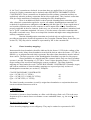
<domain operator target string-condition(s) string-changes context-condition(s)>
Only the context conditions may be optionally omitted. The domain is always @w and the
operator is always =h. The target is a list with one or more sublists, corresponding to one or
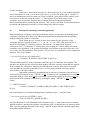
more readings, each sublist containing features to be assigned, e.g. ((<N?> N NOM SG)).
Special features like <N?> are useful because they facilitate checking the output.
The string conditions express restrictions on the segmental composition of the word-form that
must be satisfied if the rule is to be applied. The string-conditions are a list, headed by the symbol
@1, and containing one or more sublists, each expressing one requirement that is either positive
or negative. The string-conditions have the general form:
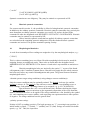
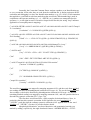
<polarity operator string>
Polarity is NOT or nothing (positive). The legal operators are ”*” (occurring in any position, i.e.
initial, medial, or final), ”^” (initial), ”~” (medial), and ”$” (final). Strings are enclosed in double
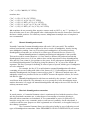
quotes, e.g. ”ed”. Thus, the expression: