1
Example
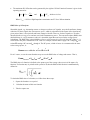
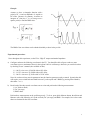
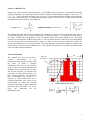
Assume we have a triangular function with a
period of T =4 and an amplitude of A with no
DC offset. Because of symmetry, it suffices to
integrate v 2, from 0 to 1, i.e., to average over a
quarter period, to find the RMS value:
At
(A t)
2
The RMS of sine waveforms can be obtained similarly as done in the pre-lab.
Experimental procedure:
Note: throughout this experiment, set the FG to “High Z” output termination Impedance
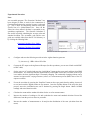
a) Configure and store the following waveforms in the FG. You should be able to figure out how to store
waveforms (up to a maximum of three) in the Agilent 54621A oscilloscope, otherwise you can find out how
by checking its user’s manual (also available on line).
1) 6.00 Vpp sine wave @ 500 Hz with no DC offset
2) 2.12 Vrms sine wave @ 500Hz with no DC offset
3) 2.00 Vrms sine wave @ 1k Hz with 2.0 V DC offset
Note: for each waveform, enter its parameters into the function generator exactly as stated. In particular, this
will require you to switch back-and-forth between V peak-to-peak and V RMS (by pressing Enter Number,
then either ∧ or ∧).
b) Recall each of the three stored waveforms one at a time and perform the following measurements:
1) AC (Peak-to-Peak)
2) DC (Average)
3) RMS values
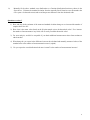
Perform these measurements on the oscilloscope only. To do so, press Quick Measure button, then Select and
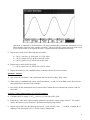
Measure each of the following: AC (Peak-to-Peak), DC (Average), and RMS. For example, here is the results
that were obtained for the first waveform:
3