1
•
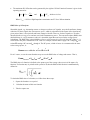
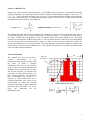
The maximum DC Offset that can be generated by the Agilent 33120A Function Generator is given in the
operating manual as:
VOffset < Vmax −
V pp
VOffset < 2V pp whichever is less
and
2
Where Vmax = 10V for a High-Impedance termination and 5V for a 50Ω termination.
RMS Value of a Waveform
Sinusoidal signals, e.g., alternating current or voltage waveforms (AC signals), are periodic and hence change
with time. For these signals, the instantaneous power, which is proportional to the square of the signal at any
given point of time, is also periodic and hence changes with time. However, for these signals, we are often
interested in the average power and not care for the instantaneous power. The root-mean-square (RMS) value
(defined below) is a single measure (value) of a sinusoidal signal that can be used in the average power
calculations. The RMS value is also called the effective value because it is effectively like a DC value, i.e., it
can be used in the power formula like a DC value. For example, assume that we apply a DC voltage VDC to a
resistor R causing a DC current IDC through it. The DC power, which of course is a constant and is the same
as the average power, is:
2
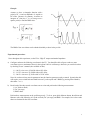
PowerDC source = VDC IDC = V
/R=I
DC
2
DC
R
For AC source, we use the same formula except we use the RMS value of voltage and current. That is,
2
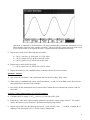
PowerAC source = VRMS IRMS = V
RMS
/R=I
2
RMS
R
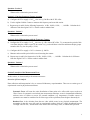
The RMS value of a function is defined as the square root of the average value (mean) of the square of a
function. If a function v(t) is periodic with a period of T, then the RMS of this function is mathematically
defined as:
To obtain the RMS value of a function, we follow these three steps:
1. Square the function over a period
2.
Calculate the mean of this new function
3. Take the square root
2