1
A. Nagy, Prof. J. Rohacs
•
•
•
•
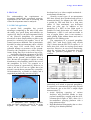
Tactical Unmanned Aerial Vehicles (PPG
may use fort such missions because its lightweight, collapsible wing, powering,
allowing the deployment of man-portable
units within minutes).
Ground Penetrating Radar (this emerging
technology developing for observing the
underground anomalies needs slow flight
ability, large wing area, keeping a fixed
altitude).
Radio Frequency Relay (ideally might be
supported by PPG having low speed long
endurance flight, high payloads, retaining its
virtually static position in low altitude flight
with sustained winds less than 10-20 mph).
Aerial monitoring of air quality (due to low
speed and altitude).
2.2. PPG aerodynamic and flight control
models
Paragliders are unique flying vehicles,
containing the flexible canopy and rigid (in case
of human operator nearly rigid) body payload.
The canopy is used for generation the
aerodynamic lift required for flights. However
aerodynamic forces and moments burning on
the canopy depend on the actual loads (form of
canopy). Generally, the estimated values from
free flight test measurements [8, 9] show that,
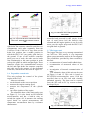
the observed maximum lift to drag ratios near
2.5, high profile drag and low maximum lift
coefficients when compared to a standard rigid
wing.
From the flight dynamics point of view, one
of the most interesting features of the
paragliders is their inconveniences to
longitudinal control. They have only lateral
control that can be realized by changing the
length of the appropriate (left or right)
suspension lines. By this way the canopy form
is shaping (deforming) and the drag as usually
rising significally and lift increasing only
slightly. So, this “breaking” and the moments
developed cause the tilt of canopy. Canopy
changes
created
by
brake
deflection
subsequently cause predictable changes in
aerodynamic loads which is leveraged for
control of the vehicle [10]. For most parafoils,
deployment of the right brake causes a
significant drag rise and a small lift increase on
the right side of the parafoil canopy combined
with slight right tilt of the canopy. The overall
effect causes the parafoil to skid turn to the right
when a right parafoil brake is activated.
The developed and deployed paraglider
dynamic models [8, 10 - 13] are based on the
simplified concept: the paraglider is the rigid
body, and the reference system is the body
system put into the centre of the paraglider. In
this case the flight dynamic can be described by
using a 6 or 9 degree-of-freedom (DOF) model.
The aerodynamic force and
moment
components generated on the canopy and
payload must be transferred to the body system.
The non-traditional model, when the
canopy is not fixed respect to the payload, the 6
DOF must include changing canopy orientation
with respect to the payload and model apparent
mass effects in a complete manner [8].
3. PPG test platform
3.1. Requirements
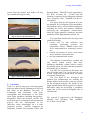
Fig. 3. The lift (CL), drag (CD) and coefficients and aerodynamic goodness factor
(K=CL/CD) of the canopy [8, 9]
The requirements to the PPG test platform
developing at the Department of Aircraft and
Ships at BME, had been defined by goals of
future application. These goals are the
following:
• investigation and calibration of the sensors
developing for the special small (leisure or
sport) flying machines, for the small aircraft
including the MEMS based sensors, micro
3