1
A. Nagy, Prof. J. Rohacs
2. PPG UAS
For understanding the requirements to
measuring platforms the operational concepts,
application of the PPG and its modeling and
control developments must be analyzed.
2.1. PPG UAS application
A special UAS, paraglider has several
advantages comparing to the other UAS when
the stable, low speed flying and mobility are
required [4]. May be, the most important benefit
of the powered paragliders for unmanned
aircraft use is their unique ability to glide to the
ground in a relatively safe manner, even if all
control systems are disabled. This is particularly
desirable in urban environments where a failure
of any large UAV would likely result in
collateral damage to structures on the ground.
Therefore the paragliders are widely used for
leisure flying, they say it is the freest way of fly.
An another important advantage of the PPG
UAV is their excellent portability [5], since it is
folded on the ground, and unfolded when it
flies. Because the paraglider is subject to wind
disturbances, the portability justifies the uses of
the paragliders as UAV, for example as a
recovery system of a spacecraft [6]. However, in
order to use the UAV not as a glider but as an
aircraft, it needs thrust generated by a propeller,
lift determined by a parafoil or canopy and a
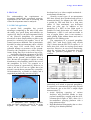
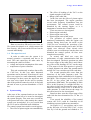
suspended payload body (traveler) (Fig.1).
developed on it, so it has coupled mechanical –
aerodynamical behaviour.
Actually several types of an autonomous
PPG have already been produced and sold on a
commercial basis. For instance, the PPG, which
is guided by GPS and flied for a long time
(about 1.5 days maximum), was developed
about ten years ago. In addition to the
portability of a PPG, its low flight speed is
suitable for land observation of a small area.
Furthermore, a PPG is safe and survivable in
case of engine failure, since it can continue a
stable gliding flight without thrust and can be
guided to a safe landing point.
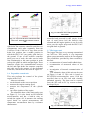
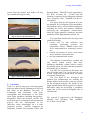
The comparison of a powered paraglider
(PPG) UAV with fixed (rigid) wing aircraft
(Fig.2.) shows that the PPG UAV requires 2 - 4
times more fuel, while its crusing speed much
more less. However, in case of area monitoring,
when the cruising time is important, then the
using the powered paragliders is a better
solution.
Fig. 2. Comparison of rigid wing aircraft and PPG
UAV
Fig. 1. Powered paraglider
The paragliders have strongly flexible
wing, the shape (and the profile) of the wing
depends on aerodynamic forces which
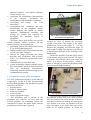
The missions outlined below are
particularly well suited to powered paragliders,
as opposed to conventional fixed-wing aircraft
and rotorcraft, due to the PPC’s unique flight
characteristics [7]:
• Aerial Spraying (spraying of various
fertilizers and pesticides thanks to large
payload capabilities, coupled with the slow,
constant-speed flight of PPG allow for a
low-turbulence spraying platform with a
long endurance time).
• High-Resolution Photography (due to slowmoving, low altitude platform).
2