1
PLCopen
for efficiency in automation
2.3
Movements
Applying a movement on a machine via a function block causes the TCP to move towards the new commanded
position. The kind of function block applied specifies the path via which the new target position is reached. (Note: the
coordinate system in which the new commanded position is specified does not have an influence on the path.)
Basically there are two types of movements which have to be distinguished:
Point - to - Point movements, PTP (also referred to as Joint Interpolated Movements):
With this type the essence is to reach the commanded position as fast as possible. This can be achieved by moving each
axis on the shortest way from its starting position to its target position. Usually this kind of movement is the fastest way
to reach a new commanded position, because at any time at least one axis moving at it’s dynamic limit. The path and
the path velocity of the TCP are not important. They are determined by the process of the positions of the axes and the
kinematic transformation of the machine. Therefore this kind of movement is applicable for handlings and whenever
the path of the TCP is not crucial. It is recommended that all axes will arrive at the commanded position at the same
point in time (synchronized).
The applicable Function Blocks as specified herein are:
• MC_MoveDirectAbsolute
• MC_MoveDirectRelative
Cartesian Path movements, CP (also referred to as Continuous Path movements):
CP movements cause the TCP to move along a defined path in Cartesian space. A path can be (a set of) a straight line,
a circular movement, or a spline function. The path via which the new commanded position is reached is important. For
example, this is essential if a workpiece is being processed. Further, the path velocity of the TCP can be controlled
directly. Contrary to joint interpolated movements the process of the position of each axis is determined by the desired
path and the inverse kinematic transformation.
The applicable Function Blocks as specified herein are:
• MC_MoveLinearAbsolute
• MC_MoveLinearRelative
• MC_MoveCircularAbsolute
• MC_MoveCircularRelative
• MC_MovePath
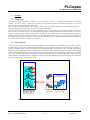
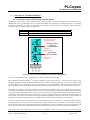
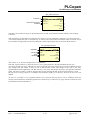
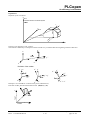
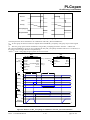
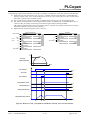
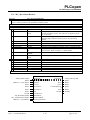
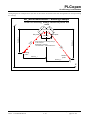
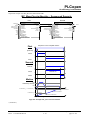
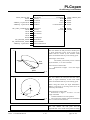
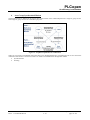
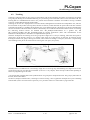
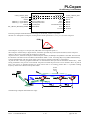
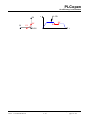
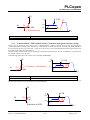
The figure below illustrates the differences between different types of movement by means of a theoretical machine.
axis
position
y
E
S
x
t
Figure 5: Different types of movements
MC_MoveDirect (black), MC_MoveLinear (green) and MC_MoveCircular (blue)
and typical positions of one of the axis of the machine participating in the movement
TC2 - Task Force Motion Control
Part 4 – Coordinated Motion
December 3, 2008
V 1.0
© PLCopen – 2007 - 2008
page 16/ 119