1
AUTOSTAR CCD PHOTOMETRY
59
APPENDIX D
Determining BVRI Extinction Coefficients
Introduction
Different photometric equipment and telescope combinations can
produce different responses to the same star. For accurate data and
data that can be combined with that taken by other observers with
other equipment, it is important to use a calibrated photometric
system. This means knowing the color transformation
coefficients of the system for the equipment. Since most CCD
photometry utilizes images of the Program and Comparison star
taken in the same field, and thus close together, the extinction
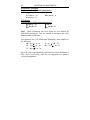
cancels when doing differential photometry. However, to
determine color transformation coefficients the extinction
coefficients must be known exactly, even for CCD photometry of
the same field. Determination of the atmospheric extinction
coefficients can be done during the same night that the color
transformation coefficients are determined. The secret is to make
several observations over a fairly wide range of air masses.
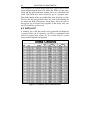
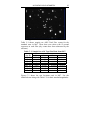
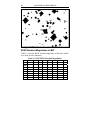
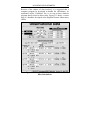
Appendix C gives information on observing the star cluster M67
for standard star data. For the extinction determination, only one
star's data needs to be used. In this case, the star labeled 081 in
M67 is used. The reason is that the color magnitudes for this star
(B–V), (I–R), and (V–I) are close to zero, and thus will minimize
any errors.
Air Mass
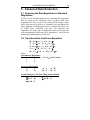
As explained in Appendix B, the Air Mass is the amount of
atmosphere that the star light has traveled through. Air Mass is a
function of the angle between the star and the Zenith (straight
overhead). Computing the air mass value is a complex process, as
described in detail in Appendix B. The Air Mass must be known
when determining both the extinction and color transformation
coefficients.