1
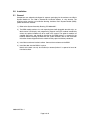
MAINTENANCE:
To keep your fire alarm system in excellent
working order, ongoing maintenance is required
per the manufacturer’s recommendations and UL
and NFPA Standards, and applicable state and
local codes. At a minimum, the requirements of
Chapter 7 of NFPA, the National Fire Alarm
Code, shall be followed. A preventative
maintenance agreement should be arranged
through the manufacturer’s local representative.
Though smoke detectors are designed for long
life, they may fail at any time. Any smoke
detector, fire alarm system, or any component of
that system shall be repaired or replaced
immediately.
OTHER CONSIDERATIONS:
The equipment was tested according to EC
directive 89/336/EEC for Class A equipment and
was verified to the limits and methods of EN
55022.
An automatic fire alarm system—typically
made up of smoke detectors, heat detectors,
manual pull stations, audible warning devices,
and a fire alarm control panel with remote
notification capability can provide early warning
of a developing fire. Such a system, however,
does not assure protection against property
damage or loss of life resulting from a fire.
reduced terminal contact pressure and difficulty
with screw terminal removal. Disconnect all
sources of power before servicing, removing, or
inserting any circuit boards. Control unit and
associated equipment may be damaged by
removing and/or inserting cards, sub-assemblies,
or interconnecting cables while the unit is
energized.
WIRING CONSIDERATIONS:
This fire alarm control panel contains powerlimited circuits. You cannot connect external
sources of power to these circuits without
invalidating their approval.
Verify that wire sizes are adequate for all
initiating device and notification appliance
circuits. Most devices cannot tolerate more than
a 10% drop from the specified device voltage.
The installer must make sure that the wiring and
devices installed in the system meet the current
National Electrical Code, NFPA 70, and all
applicable state and local building code
requirements.
Use the conductor size and type required by local
codes. (See NFPA 70, Article 760). Wiring
resistance must not be more than that shown on
the field wiring diagrams.
To reduce errors and help in servicing the
system, all conductors should be tagged or
otherwise coded and logged at installation to
identify circuit assignment and polarity. If the
conductors are logged with a code, keep the log
that explains the code with the manual, so that it
is available to other people working on the panel.
Like all solid state electronic devices, this system
may operate erratically or be damaged when
subjected to lightening induced transients.
Although no system is completely immune to
lightening transients and interference, proper
grounding will reduce susceptibility. We do not
recommend the use of overhead or outside aerial
wiring due to the increased susceptibility to
nearby lightening strikes. Consult with the
Gamewell-FCI Technical Support Department if
any problems are anticipated or encountered.
To prevent the spread of fire, use proper patching
materials to areas where system wiring passes
through the fire-rated walls or floors.
The Manufacturer recommends that smoke
and/or heat detectors be located throughout a
protected
premise
following
the
recommendations of the current edition of the
National Fire Protection Association NFPA
Standard 72, manufacturer’s recommendations,
State and local codes. A study by the Federal
Emergency Management Agency (an agency of
the United States government) indicated that
smoke detectors may not into alarm in as many
as 35% of all fires. While fire alarm systems are
designed to provide early warning against fire,
they do not guarantee warning or protection
against fire. A fire alarm system may not provide
timely or adequate warning, or simply may not
function, for a variety of reasons:
Smoke detectors may not sense fire where
smoke cannot reach the detectors such as in
chimneys, in or behind walls, on roofs, or on the
other side of closed doors. Smoke detectors also
may not sense a fire on another level or floor of a
building. A second-floor detector, for example,
may not sense a first-floor or basement fire.
SURVIVABILITY:
Per the National Fire Alarm Code, NFPA 72, all
circuits necessary for the operation of the
notification appliances shall be protected until
they enter the evacuation signaling zone that
they serve. Any of the following methods shall be
considered acceptable as meeting these
requirements:
1)
2)
3)
A 2-hour rated cable or cable system
A 2-hour rated enclosure
Performance alternatives approved
Authority Having Jurisdiction
Particles of combustion or “smoke” from a
developing fire may not reach the sensing
chambers of smoke detectors because:
• Barriers such as closed or partially closed
doors, walls, or chimneys may inhibit particle or
smoke flow.
by
• Smoke particles may become “cold,” stratify,
and not reach the ceiling or upper walls where
detectors are located.
9000-0447 Rev. I
ii