1
Dynamics 101 Revisited
Compression
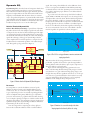
A compressor, when the input signal reaches the level set by the
threshold control, begins turning down the signal by an amount
set by the ratio control. Modern compressors make the loud signals quieter, but do not make the quiet parts louder. (However,
by keeping the loud signals under control, you can turn up the
output level, which will make the quiet parts louder along with
the rest of the signal.)
Primary uses are 1) reduce dynamic range of vocalists and
other musical instruments that exceed the recording or reproduction capability; 2) prevent clipping and distortion in live
sound systems or recording chains; 3) smooth and balance an
instrument such as a bass guitar with wide dynamic range and
string-to-string level variations; 4) reduce vocal sibilance (deesser); 5) produce louder recordings for broadcast; and 6) evenout paging variations due to different speakers in large systems.
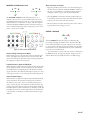
COMPRESSOR
-10
Output Level dBu
Introduction
Compressors and limiters are in the business of automatically
controlling the volume or dynamics of sound, just like your
hand on the fader, or the fat man dancing in front of the midrange cabinet. Used wisely, often in conjunction with each other
or with equalization or filtering, dynamics processors improve
the intelligibility of voice and the subjective effect of music.
However, in the wrong hands they can sound terrible.
Heavy compression (low threshold and a high ratio) often
sounds nasty. The timbre of the sound changes, becoming hard
and closed and not nearly as sweet and open as the sounds
you envisioned when you got into this business. On the other
hand, attack times optimized for pleasant compression may
not track initial transients quick enough. In addition, pumping and breathing may accompany heavy compression, i.e., the
background noise rises way out of proportion to the foreground
sound as the compressor releases. Result: it just does not sound
good.
Therefore, no matter how you slice it, compressors and limiters are just fancy electronic volume controls. Think of them as an
extra hand on a control, turning the volume down and turning
it back up again. Luckily, this electronic hand is quick and accurate, but it is just adjusting a volume control.
0
The Ratio controls
the amount of gain
reduction above
the Threshold
-20
2
1.5
1
5
n:1
Side-chain
The side-chain is the hand that controls the volume. Side-chain
circuitry, also known as the detector, examines the input signal
and issues a control message to adjust the gain of the main signal
path.
Full-featured compressors, like the C4, offer both internal
and external side-chain options. When the internal option is
selected the compressor’s input signal feeds the detector. This
arrangement works well for most applications, and is especially
Manual-2
10
RATIO
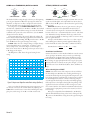
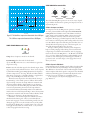
Limiter = ∞:1
:1
=2
-20
-10
-30
-40
0
+10
dBu
+22
LIMIT THRESHOLD
The Limiter Threshold
controls the hinge point
of a Ratio set at ∞:1
:1
1
at
et
ss
-40
io
at
ll R
-50
-60
io
Rat
sor
s
pre
Com
-30
g
in
No
s
es
oc
pr
-60
—
a
-20
-10
-30
0
+10
-40
+20
dBu
COMP THRESHOLD
The Compressor Threshold
controls the hinge point
-50
-40
-30
-20
-10
0
+10
+20
Input Level dBu
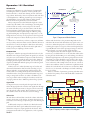
Figure 1. Compressor and Limiter functions
effective with the C4 due to the parametric EQ built into the
side-chain. The external side-chain allows any signal source, connected to a dedicated input jack, to feed the detector, thereby determining the compressor’s response. This external signal may be
a specially filtered version of the input signal, using an outboard
EQ for example, or it may be another signal altogether.
It is important that the side-chain signal is not heard. For
instance, if you added treble boost to the side-chain audio (either
by using the C4’s built-in PEQ or an outboard EQ), it would not
affect the high frequencies in the main signal path, but it would
cause them to cross the threshold sooner and more often. Large
peaks of treble would cause heavy compression with no compression at other times. This example is the basic de-esser, a circuit to
remove excess sibilance. (There is a much more sophisticated and
effective de-esser built-into the C4, but more on that later.) With
a bass boost, you can make a de-thumper, and with a midrange
boost a de-nasaler.
There are a number of parameters governing side-chain activity, but the four primary ones are Threshold, Ratio, Attack time
and Release time.
BROADBAND
GAIN CONTROL
INPUT
Signal Path
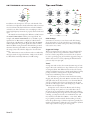
A compressor has two internal paths: the signal and the sidechain. The signal path is the route the main signal takes through
the unit: from the input circuits to the gain control section and
exits through the output circuits. The signal chain goes through
the “volume control” in the “hand on a control” analogy.
LIMITER
THRESHOLD
OUTPUT
RATIO
ATTACK RELEASE
SCALE
FILTER
FREQ BW GAIN
SIDE-CHAIN EQ
RMS
DETECTOR
GAIN COMPUTER
SIDE-CHAIN
Figure 2. Frequency sensitive compressor block diagram.