1
DATA, CLOCK AND CARD PRESENT SIGNALS
The following is a timing diagram of typical DATA and CLOCK signals from
ID TECH electronics:
CLOCK: The CLOCK output is narrow pulse normally high, and goes low
when data is valid. The data level is stable at both the rising and falling edges
of the CLOCK pulse. CLOCK pulse width is typically 32 microseconds.
CARD PRESENT: The CARD PRESENT signal indicates data is being read
from the media being passed through the slot. It will not switch until flux
reversals (magnetic pulses) have been detected. After the flux reversals have
been detected, CARD PRESENT goes low. It stays low throughout the reading process and for 5 to 10 milliseconds, after the last flux reversal is read.
Typically, CARD PRESENT is used to signal the start and finish of a card
read. It may also be used as an interrupt signal for alerting the firmware that
the reading operation is in process.
DATA: The DATA output level indicates the value of the bit being decoded
during a CLOCK pulse. It is a low level for ones (1) and a high level for
zeros (0). The DATA signal’s level is steady at the rising and falling edges
and during the low level of the CLOCK pulse.
SPECIFICATIONS
Operating
Temperature:
32° F to 131° F (0° C to 55° C).
Storage
Temperature:
-22° F to 158° F (-30° C to 70° C).
Humidity:
Maximum 95% non-condensing.
MTBF:
Read electronics, 21,000,000 POH.
Magnetic
Head Life:
1,000,000 passes minimum.
Rail and
Cover Life:
1,000,000 passes minimum.
Read Rate:
Less than one error in 100,000 bits on
cards conforming to ISO7811 1-5 (not
induced by operator error).
Swipe Speed:
3 to 60 inches per second, bi-directional.
Card Thickness:
.01 to .045 inches.
Slot Width:
.050 inches (1.37mm).
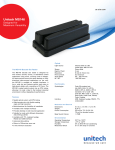
Dimensions:
Length: 5.22 inches (133mm).
Width: 1.25 inches (32mm).
Height: 1.6 inches (41mm).
Weight:
8 oz.
Cable Length:
6-foot straight cable.
5
DATA, CLOCK AND CARD PRESENT SIGNALS
The following is a timing diagram of typical DATA and CLOCK signals from
ID TECH electronics:
CLOCK: The CLOCK output is narrow pulse normally high, and goes low
when data is valid. The data level is stable at both the rising and falling edges
of the CLOCK pulse. CLOCK pulse width is typically 32 microseconds.
CARD PRESENT: The CARD PRESENT signal indicates data is being read
from the media being passed through the slot. It will not switch until flux
reversals (magnetic pulses) have been detected. After the flux reversals have
been detected, CARD PRESENT goes low. It stays low throughout the reading process and for 5 to 10 milliseconds, after the last flux reversal is read.
Typically, CARD PRESENT is used to signal the start and finish of a card
read. It may also be used as an interrupt signal for alerting the firmware that
the reading operation is in process.
DATA: The DATA output level indicates the value of the bit being decoded
during a CLOCK pulse. It is a low level for ones (1) and a high level for
zeros (0). The DATA signal’s level is steady at the rising and falling edges
and during the low level of the CLOCK pulse.
5
2
SPECIFICATIONS
Operating
Temperature:
32° F to 131° F (0° C to 55° C).
Storage
Temperature:
-22° F to 158° F (-30° C to 70° C).
Humidity:
Maximum 95% non-condensing.
MTBF:
Read electronics, 21,000,000 POH.
Magnetic
Head Life:
1,000,000 passes minimum.
Rail and
Cover Life:
1,000,000 passes minimum.
Read Rate:
Less than one error in 100,000 bits on
cards conforming to ISO7811 1-5 (not
induced by operator error).
Swipe Speed:
3 to 60 inches per second, bi-directional.
Card Thickness:
.01 to .045 inches.
Slot Width:
.050 inches (1.37mm).
Dimensions:
Length: 5.22 inches (133mm).
Width: 1.25 inches (32mm).
Height: 1.6 inches (41mm).
Weight:
8 oz.
Cable Length:
6-foot straight cable.
2