1
Chapter 1: Introducing T-SQL and Data Management Systems
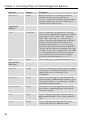
Data Type
Storage
Description
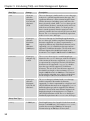
smallmoney
4 bytes
Bill Gates needs the money data type to track his
portfolio, but most of us can get by with the
smallmoney data type. It consumes 4 bytes of storage
and can be used to store values of −214,748.3648 to
+214,748.3647 of a monetary unit.
float
4 or 8 bytes
The float data type is an approximate value (SQL
Server performs rounding) that supports real numbers
in the range of −1.79E + 308 to −2.23E − 308, 0 and
2.23E − 308 to 1.79E + 308. float can be used as a
4-byte or 8-byte data type, depending on an optional
mantissa value (the number of bits used to store
the mantissa of the float). float(24) or any value
between 1 and 24 will cause the float to be defined as
a 4-byte value that can store real numbers in the range
of −3.40E + 38 to −1.18E − 38, 0 and 1.18E − 38 to 3.40E
+ 38. Any number between 25 and 53 will cause the
float to be defined as an 8-bit float (aka, a double
precision) in the default manner of float(53).
real
4 bytes
The real data type is a synonym for a 4-byte float.
datetime
8 bytes
The datetime data type is used to store date and time
from January 1, 1753 through December 31, 9999. The
accuracy of the datetime data type is 3.33
milliseconds.
*datetime2
8 bytes
The datetime2 data type is used to store date and
time from January 1, 0001 through December 31, 9999.
The accuracy of the datetime2 data type is variable
but defaults to 100 nanoseconds.
smalldatetime
4 bytes
The smalldatetime data type stores date and time
from January 1, 1900 through June 6, 2079, with an
accuracy of 1 minute.
*date
3 bytes
The date data type stores dates only from January 1,
0001 through December 31, 9999, with an accuracy of
1 day.
*time
5 bytes
The time data type stores time-only data, with a
variable precision of up to 100 nanoseconds
Approximate
Numerics
Date and Time
Data Types
10