1
KLAUS UNION GmbH & Co. KG
Page 2 / 7
2.2 Dangers that can result if safety instructions are not observed.
alities> of these operating instructions. The limits included in the
technical documentation must not be exceeded.
The non-observance of the safety instructions may cause risks
to persons, the environment and the valves or plants. The nonobservance of the safety instructions may lead to the loss of
any indemnity rights.
3. Corrosion protection, transport and
storage
In particular the non-observance of the safety notes can cause
dangers such as:
-
break down of important functions of the valves / plants
-
failure of prescribed methods of maintenance and commissioning
-
danger to persons caused by electrical, mechanical and
chemical impacts
-
environmental injuries caused by a leakage of dangerous
materials
2.3 Working with safety consciousness
The safety instructions included in these operating instructions,
the national regulations for prevention of accidents, as well as
the internal regulations referring to work, operation and safety
have to be observed by the operator.
2.4 Safety instructions for the operator / user
-
Whenever some hot or cold valve parts (e.g. casing parts,
lever or handwheel) may cause any danger, the operator
must construct these parts in a way that they are protected
from contacts.
-
The contact protection for moving parts (such as lever or
weight) must not be taken away while the machine is working.
-
Leakages (f. ex. in shaft sealing) of dangerous conveyed
materials (explosive, toxic, hot) have to be removed in a
way that no danger to persons or environment can arise.
Legal determinations must be respected.
-
Injuries by electrical energy have to be excluded (please
find details to this point in the VDE and local power supply
enterprise regulations).
2.5 Safety instructions for maintenance, inspection and assembly works.
3.1 Corrosion protection
3.1.1
Carbon steel valves
Valves made out of unalloyed or low alloyed cast steel are
painted with a hard sticking primer made of a 2-components
colour based on epoxy resin paint. The minimum film thickness
is 70 µm. The inner surfaces are free of paint and only coated
with a temporary corrosion protection (e.g. oil). Machined flange
facings are protected against outside influences with a strippable varnish.
3.1.2
Austenitic valves
Valves made out of stainless austenitic cast steel will be delivered without coating.
3.2 Transport
The valves are delivered with their connecting holes shut by
cover caps. See that valves are not thrown or exposed to hard
crushes.
Valves will be supplied as ready for operation.
ATTENTION During transport and intermediate storage valves
have to be closed. Connecting holes have to be shut up by
suitable means (cover caps, foils) in order to avoid any damage
to the valve seats.
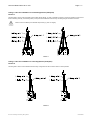
Please see on this the “rise prescriptions“on page 7!
Valve weights are indicated in the corresponding manufacturer
documents (type sheets, paragraph 4.1 <Corresponding documents>, acknowledgement)
After delivery, respectively before assembly the valves have to
be inspected in order to exclude any transportation damage.
3.3 Storage
It must be provided that all maintenance, inspection and assembly works are executed by skilled staff, who must have previously studied these operating instructions.
The storage / intermediate storage of the valves has to be effected in a way that it can work perfectly even after a longer
storage period. For this purpose it is necessary:
Basically when any kind of work on valves is executed, they
have to be cooled down and free of pressure. And the vaporisation temperature of the medium must be lower than the temperature of all parts it gets in contact with.
-
to keep the valve closed (in order to protect the seat facings)
-
to take measures against soiling (dust, sand, mortar, respectively building materials), frost and corrosion (e.g. using plastic foils)
Valves which get in contact with health injuring media have to
be decontaminated.
Immediately after the work is done, all safety and protection
devices have to be put into position or operation again. Before
putting the valve into operation again, the points referring to
paragraph 6 <Putting into operation> have to be observed.
2.6 Independent conversion and spare parts
manufacture
Reconstructions or modifications of the valves are only acceptable under agreement with the manufacturer. The use of original spare parts and by the manufacturer authorised accessories
promotes safety. Any violations cause the liability for the consequences arising to be cancelled.
When storing valves with soft gaskets (seat and / or stem seal
of elastomer) the storage regulations for elastomer (DIN 7716)
have to be observed:
-
the store must be dry, free of dust and moderately ventilated. Store temperature should not go over +25 °C
-
stocks on hand have to be used up in order to avoid long
storage periods
-
as already mentioned above, the valves have to be in
”closed“position during the storage. However the soft closure elements should be shut with little power, in order to
avoid a rush ageing of the elastomer
2.7 Inadmissible operation modes
A safe operation is only guaranteed if the valves are used according to the determinations included in paragraph 1 <Gener-
BA 1731-1733 Swing check valves_Rev.2_EN.doc
Issue 09/2011