1
20766 Appendices.fm Seite 186 Donnerstag, 1. Februar 2001 1:57 13
Appendix B: Troubleshooting the DIG System
1. Possible Problems and Recommendations
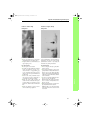
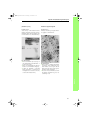
Problem 4: Irregular, Smeared, Grainy
Background
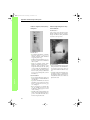
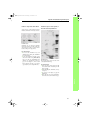
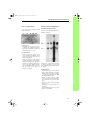
Problem 5: High Background on Only
Part of Membrane
Possible cause 1
(Data courtesy of Dr. Bacchetti and Dr.
Marusic, McMaster University, Canada.)
Drying of membrane during chemiluminescent detection procedure.
Possible causes
● Non-uniform distribution of chemiluminescent substrate, e.g. due to performing incubation while membrane
wrapped in plastic wrap.
● Wrinkles in the hybridization bag, causing uneven contact between membrane
and X-ray film.
● Drying of membrane during chemiluminescent visualization procedure.
Note: The grainy appearance of the
background indicates that the drying
occurred during the chemiluminescent
procedure rather than during hybridization. Drying during hybridization
leads to a cloudy background (as shown
in Problem 3).
Appendices
Recommendation
● Do not wrap membrane in plastic wrap
during incubation with chemiluminescent substrate.
● Spread the chemiluminescent substrate
uniformly over the surface of the membrane, as described in Section 4.1, page
112 of Chapter 2.
● Before exposing bag to X-ray film, flatten any wrinkles between blot and
membrane by rolling a pipette over the
surface of the bag.
● Carefully seal the damp membrane (in a
folder or bag) during the incubation/exposure to X-ray film. Check the seals to
make sure liquid cannot leak.
186
Recommendation
● Do not wrap membrane in plastic wrap
during incubation with chemiluminescent substrate. Plastic wrap cannot be
sealed and will allow membrane to dry
out.
● Carefully seal the damp membrane (in a
development folder or hybridization
bag) during the incubation/exposure to
X-ray film. Check the seals to make sure
liquid cannot leak.