1
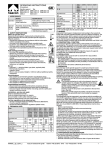
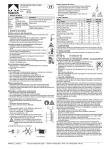
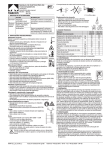
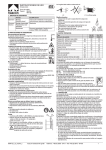
Hard solder the rope end clamp to the rope drum with a hexagonal
wrench (SW 4 with 6 Nm, SW 5 with 5 Nm) (fig 1and fig. 2).
After rotating the crank in clockwise direction, the rope must reel up on
the drum as illustrated in fig. 3.
fig. 1
9. MAINTENANCE RECOMMENDATION
The operator determines the intervals themselves based on frequency
of use and the operating conditions.
–– Regular cleaning, no steam jets!
–– Carry out visual check on inaccessible brakes / locks every 5 years at
the latest, replace brake pads as required.
–– General overhaul by the manufacturer after 10 years at the latest.
CAUTION!
Only perform inspection, maintenance and repair work on an
unloaded hoist. Only allow work on brakes and locks to be performed by qualified specialist personnel.
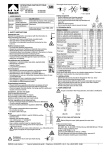
fig. 3
fig. 2
A functional test must always be accomplished before beginning work.
7. OPERATION
Lift the load: Turn crank clockwise.
Lower the load: Turn crank anti-clockwise.
If the crank is not turned the load is suspended safely. When lifting a
load, do not wind rope beyond the point where at least 1,5 x rope diameter is left free on drum flanges above outermost layer.
When loaded, at least 2 turns of the rope must remain on the
drum. The capacity of the first layer corresponds to the nominal capacity of the winch. This means that the capacity decreases with every
further layer (refer to type-/ capacity number plate for capacity of first
and last layer).
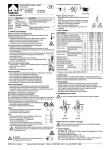
Version with crank to declutch rope drum (option)
Only for unloaded rope.
Declutchable rope drum:
zz Push crank arm towards the rope winch. The coupling pins move out
of the coupling disc. Unloaded rope can be pulled off.
Maintenance and inspection work
Visual check of the rope hooks (load carrier)
Function of the winch
Condition of the rope and lifting equipment
Brake function under load
Grease bearing of drive pinion
Check rope for wear acc. to DIN ISO 4309 and service
Check fastening bolts for secure seating
Check all parts of the winch and crank for wear, if applicable, replace defective parts and lubricate.
Check type plate for legibility
Have an inspection performed by an expert
Intervals
Before
every use
Quarterly
Annually
Annually
Lubricant recommendations: Multi-purpose grease per DIN 51502 K3K-20
Safety crank
If sluggishness occurs during lowering, pour a
few drops of oil into the gap in the crank cam.
Safety cranks with a gap aperture >30°
should be replaced. Repair must be carried
out by only by the manufacturer.
1- 3
Clutch in:
zz Pull and turn crank until the coupling pins engage into the coupling disc.
Version with adjustable crank arm (option)
zz Loosen wing screw, adjust crank radius, tighten wing screw.
30° max
Version with detachable crank(option)
CAUTION!
Only disassemble the crank, ratchet
brace and locking pawl when the
equipment is not under load!
Do not oil or grease the brake pads!
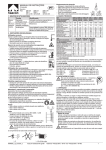
10. OPERATION FAILURES AND THEIR CAUSES
Failure
In unloaded state, it
is difficult to turn the
crank
8. INSPECTION
The equipment must be inspected in accordance with the conditions of
use and the operating conditions at least once per year by an authorised
person 2 per TRBS 1203 (Technical expert) (testing per BetrSichV, §10,
sect.2 represents implementation of EC Directives 89/391/EEC and
95/63/EC and the annual occupational safety inspection per BGV D8,
§23, sect. 2 and BGG956). These inspections must be documented:
–– Before commissioning.
–– After significant alterations before recommissioning.
–– At least once per year.
–– In the event of unusual occurrences arising that could have detrimental effects on the safety of the winch (extraordinary tests, e.g. after a
long period of inactivity, accidents, natural events).
–– After repair works that could have an influence on the safety of the
winch.
Technical experts (AP2) are persons, who have sufficient knowledge
based on their specialist training and experience, in the areas of
winches, lift and pull systems and the relevant official occupational
health and safety rules, accident prevention regulations, guidelines and
generally accepted engineering rules (e.g. EN standards), to evaluate
the operational safety of winches, and lift and pull systems. Technical
experts (AP2) are to be nominated by the operator of the equipment.
Performance of the annual occupational safety inspection as well as the
training required to obtain the aforementioned knowledge and skills can
be provided by haacon hebetechnik.
094297_e_gb_hseilw_s
Load is not held
Cause
Lubricant in bearing
points is missing.
Dirt or something
similar has accumulated in the bearing
Winch was distorted
during mounting.
Wrong coiling of
the rope winding
direction for lifting
was not correct.
The brake is wornout.
Too light load
Brake does not
Brake discs or
release, load may
brake mechanism is
only be lowered with distorted.
high expenditure of
force.
Elimination
Execute maintenance
works
Check the fixing.
Is the mounting
surface even, are
the screws tightened
correctly
Lay the rope correctly.
Check brake parts
and replace worn-out
parts.
The load has to be at
least ca. 20 kg resp.
50 kg
Release the brake by
slightly striking against
the crank arm with
the flat of the hand in
lowering direction.
11. SPARE PARTS
When ordering spare parts it is e s s e n t i a l to quote:
–– The type and serial number of the equipment / item and part number
12. DISASSEMBLY, DISPOSAL
–– Make sure to observe the safety instructions.
–– Dispose of the equipment and the substances within it in an environmentally responsible manner.
haacon hebetechnik gmbh – Phone +49 (0) 9375 - 84-0 – Fax +49 (0) 9375 - 8466
2