1
Chapter13 - CM Box User Guide
2 of 9
http://80.69.76.153/wiki/index.php?title=Chapter13&printable=yes
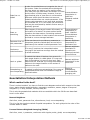
Scale free vs.
scaled
A scale free method does not recognize the size of
the system. Scale free methods do not distinguish
the case where one station is 10m and the other
30m away from the case where one station is 100km
and the other is 300km away. However, from an
agroclimatical point of view there is a tremendous
difference which should be taken into account.
Scaled methods often use a scale parameter. If the
chosen scale parameter is too large local variations
are smoothed out. If it is too small, the information
that may be contributed by stations further away is
practically ignored.
Inverse distance
interpolation is
scale free.
Shepards method
is scaled.
Exact vs.
smoothing
What happens if the target location falls exactly on
the location of a station? An exact method would
reproduce the observations. Smoothing methods
take the observations of other locations into account
and lead to a more averaged estimate.
Inverse distance
interpolation is
exact. Modified
inverse distance
interpolation is
smoothing.
If the user has not to provide any parameter to
Parameter free vs.
interpolate (and the method does not use built-in
with parameters
parameters) the method is called parameter free.
Nearest neighbour
interpolation is
parameter free.
Continuous
vs.dsicontinuous
If for any 2 locations the interpolated values
converge if the locations converge then the method
is called continouos.
Nearest neighbour
interolation is
discontinuous.
Global polynomials
are continuous.
Local vs. global
A method that takes all stations into account for
each target location is called global. If it uses only
part of the stations it is more or less local. Each
method can be ‘localized’ by limiting the distance of
stations to the target location or the number of
stations to be used.
Nearest neighbour
interpolation is the
most local.
Extrapolating vs.
non-extrapolating
A method is called non-extrapolating if the range of
interpolated values does not exceed the range of
observed values.
Kriging is
extrapolating,
inverse distance
averaging not.
Geostatistical Interpolation Methods
Which method is the best?
There is no best method. You have to find the most adequate method with respect to the data
given, station density and distribution, geographic conditions, season, degree of temporal
integration (i.e. daily, decadal, monthly data) etc.
This is why the geostatistical methods which are available within the CM Box are described
here in more detail.
Nearest Neighbour
Scale free, exact, parameter free, discontinuous, local, non-extrapolating
This is by far the simplest method of spatial interpolation. For each grid point the value of the
nearest station is taken.
Inverse Distance Weighted Averaging (IDWA)
Scale free, exact, 1 parameter, continuous with singular points, global, non-extrapolating
11/14/2006 3:37 PM